
Unit 3 Project — Invent & Pitch
Run after: Sessions 9–12 · Time: one 60-min session (extra prototype time can be set as homework) · Ages: 8–11
Project goal: each student finds a real problem someone has, designs and prototypes a solution, and pitches it clearly.
What students build
Students use design thinking to invent something that solves a real problem for a real person. They describe who has the problem, sketch or build a prototype (a rough model — drawing, cardboard, slides, or a simple diagram), and deliver a short pitch explaining the problem and how their idea helps. The solution may (but need not) use AI or data from earlier units.
Concrete ideas a student could pick:
- A gadget that helps a forgetful person remember to take their water bottle to school.
- An app that sorts a messy bookshelf using an image model like the one from Unit 1.
- A better lunch-queue system designed from data about which times are busiest.
Steps
- Find a real problem — something that annoys or slows down a real person (yourself, a family member, a classmate). Write it as "Someone needs a way to…".
- Say who has the problem and why it matters to them.
- Brainstorm 3 possible solutions, then pick the one that is most helpful and doable.
- Sketch your idea and label the important parts — what it does and how a person uses it.
- Build a prototype: a drawing, a cardboard/craft model, a few slides, or a simple diagram. It does not need to work for real.
- Test the idea on one person (or imagine walking them through it) and note one thing to improve.
- Improve that one thing, then prepare a 1–2 minute pitch: the problem, who it helps, your solution, and why it's better.
- Practise the pitch once out loud before presenting.
Deliverable
A prototype (sketch, model, slides, or diagram) plus a 1–2 minute pitch that names the problem, the person it helps, the solution, and one improvement the student made after testing.
The rubric scores four rising levels:
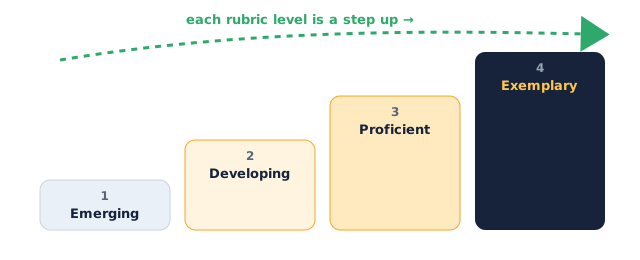
Assessment rubric
| Criterion | Emerging (1) | Developing (2) | Proficient (3) | Exemplary (4) |
|---|---|---|---|---|
| Finding a real problem | No clear problem, or not a real need | Problem is vague or nobody really has it | Clear real problem tied to a specific person | Well-chosen problem that genuinely matters, explained convincingly |
| Designing a solution | Idea missing or unrelated to the problem | Idea only partly solves the problem | Solution clearly addresses the problem and is doable | Thoughtful solution; considered options and picked the best |
| Building a prototype | No prototype, or too unclear to understand | Prototype is bare with few labels | Prototype clearly shows how the idea works, with labels | Prototype is clear, detailed, and improved after testing |
| Pitching the idea | Cannot explain the idea to others | Explains parts but audience is left confused | Clear pitch: problem, person, solution, why it helps | Confident, persuasive pitch that makes the audience care |
Instructor tips
- Running it: keep the focus on the problem first — students love jumping to gadgets. Make everyone finish the "Someone needs a way to…" sentence before they design anything.
- Timing: ~10 min to find and frame a problem, ~10 min to brainstorm and choose, ~20 min to sketch/build, ~5 min to test and improve, ~15 min for pitches.
- Differentiation: strugglers pick a problem from a short list you provide and use a sketch-only prototype. Confident students connect their solution to Unit 1 (an AI model) or Unit 2 (data) for extra depth.
- Low-tech fallback: no craft materials or devices needed — a labelled sketch on paper is a perfectly valid prototype, and pitches can be spoken with the sketch held to the camera.
- Watch for: "solutions looking for a problem." If a student can't name who has the problem, send them back to Step 1 before they build.