
Course Capstone — Build Something That Helps
Run after: Sessions 1–14 · Time: two 60-min sessions (build, then showcase) — or one session with build time at home · Ages: 8–11
Project goal: each student creates a bigger project that uses AI and/or data for a real-world purpose, and presents it at a class showcase.
What students build
This is the course finale: a project that combines what they learned across the units and does something genuinely helpful. Students choose a real-world purpose, then use at least one of the tools they've met — a Teachable Machine model, data and a chart, a designed prototype, or a generative-AI idea — to serve it. They present it at a showcase where every student demos their work.
Concrete ideas a student could pick:
- A recycling helper — a Teachable Machine model that sorts items into "recycle / trash / compost."
- A "healthy snacks" campaign — a survey and chart showing what the class eats, plus a recommendation poster.
- A homework-reminder invention — a prototype gadget or app, pitched with a data chart showing which day is busiest.
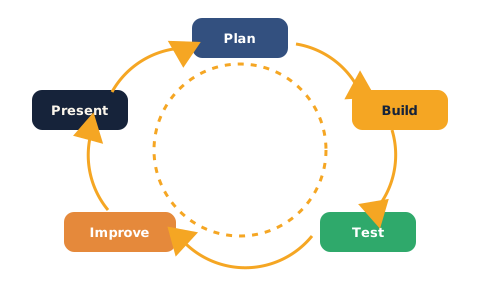
Your project moves through a cycle:
Steps
- Choose a real-world purpose — something that helps a person, a group, or the planet. Finish: "My project helps ___ by ___."
- Decide which tools you'll use: an AI model, data and a chart, a prototype, a generative-AI idea — at least one, and combine them if it helps.
- Make a simple plan: what you'll build, what examples or data you need, and what "finished" looks like.
- Build the main piece — train the model, collect the data and make the chart, or build the prototype.
- Test it honestly and fix one weakness (add examples, tidy the data, improve the prototype).
- Prepare a showcase presentation (2–3 min): the purpose, what you built, a live demo or walkthrough, one honest limitation, and one way it could grow.
- Make a title card or slide with the project name and the sentence from Step 1.
- Practise once, then present at the showcase.
Deliverable
A completed project (model, chart-based report, and/or prototype) with a title card, presented as a 2–3 minute showcase demo that states the purpose, shows the work, and names one honest limitation.
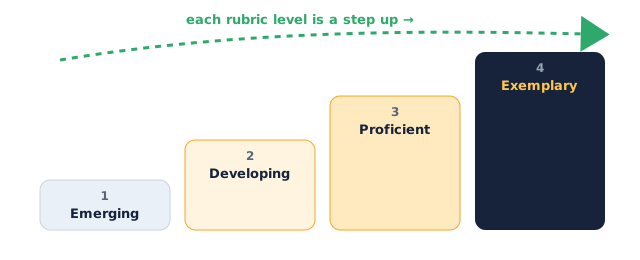
The rubric scores four rising levels:
Assessment rubric
| Criterion | Emerging (1) | Developing (2) | Proficient (3) | Exemplary (4) |
|---|---|---|---|---|
| Real-world purpose | No clear purpose, or it doesn't help anyone | Purpose is vague or only loosely helpful | Clear purpose that genuinely helps someone | Meaningful purpose, well argued, that others care about |
| Using the tools (AI / data / build) | Tool barely used or not working | One tool used but shakily | At least one tool used well and correctly | Tools combined skilfully to serve the purpose |
| Building & honest testing | Project unfinished or untested | Mostly built but weaknesses ignored | Working project, tested, one weakness fixed | Polished, robust project; limitations named and addressed |
| Showcase presentation | Cannot present the project clearly | Presents parts; audience left unsure | Clear demo: purpose, work, and one honest limitation | Confident, engaging demo that tells a complete story |
Instructor tips
- Running it: split it across two sessions if you can — one to build and test, one for the showcase. If time is tight, set building as homework and keep the whole session for demos.
- Timing (showcase): budget ~3 min per student plus a moment of applause and one kind question from the class. Keep a visible timer.
- Differentiation: strugglers reuse and extend a single earlier project (e.g. polish their Unit 1 model for a real purpose). Confident students combine two tools (AI + data, or data + prototype).
- Low-tech fallback: a fully paper-and-pitch capstone is valid — a labelled prototype plus a hand-drawn chart still meets every criterion. What matters is a real purpose, honest testing, and a clear presentation.
- Make it a celebration: invite families to watch if possible, and have each student say one thing they're proud of. This is the moment the course has been building toward.