
Unit 2 Project — Data Detective Report
Run after: Sessions 5–8 · Time: one 60-min session (data collected as homework beforehand) · Ages: 8–11
Project goal: each student picks a real question, collects data to answer it, turns it into a clear chart, and tells the data story with a sensible recommendation.
What students build
Students act as data detectives: they choose a question they genuinely wonder about, gather data (a small survey or tally), organise it in Google Sheets, make one clear chart, and write a short data story that ends in a recommendation. The whole thing fits on one page or one slide.
Concrete ideas a student could pick:
- "What's our class's favourite break-time game?" — survey 10+ classmates or family members.
- "Which day of the week has the most homework?" — tally over a week.
- "What drink do people in my house choose most?" — tally over a few days.
Steps
- Choose one clear question that has a small number of possible answers (not "what's your favourite anything").
- Decide how to collect data — a survey with fixed choices, or a tally chart — and gather at least 10 responses.
- Enter the results in Google Sheets: one column for the categories, one column for the counts.
- Check the data makes sense: totals add up, no blank or silly entries, spelling of categories consistent.
- Insert one chart that fits the data (a bar chart for categories) and give it a clear title and labels.
- Read the chart like a detective: which is the biggest, the smallest, and one thing that surprised you.
- Write the data story in 3–4 sentences: the question, what the data shows, and a recommendation based on it.
- Get ready to present the chart and story in about one minute.
Deliverable
A one-page report or single slide containing: the question, the chart (with title and labels), and a 3–4 sentence data story ending in a recommendation — presented briefly to the class.
The rubric scores four rising levels:
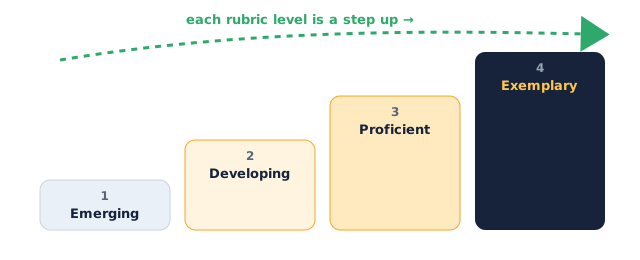
Assessment rubric
| Criterion | Emerging (1) | Developing (2) | Proficient (3) | Exemplary (4) |
|---|---|---|---|---|
| Question & data collection | No clear question, or data barely collected | Question is vague or fewer than 10 responses | Clear question with 10+ tidy, relevant responses | Sharp question with well-organised data and enough responses to trust |
| Organising the data | Data messy or miscounted | Some errors or inconsistent categories | Data tidy in Sheets, totals correct, categories consistent | Data checked carefully; spots and fixes an error or odd value |
| Making the chart | No chart, or wrong type / unreadable | Chart present but missing title or labels | Correct chart type with clear title and labels | Chart is clean, well-chosen, and easy to read at a glance |
| Telling the data story | Cannot say what the data shows | States one fact but no interpretation | Reads the chart and gives a sensible recommendation | Interprets the data, notes a surprise, and justifies a strong recommendation |
Instructor tips
- Running it: the data collection is homework — send the question and method home a few days early so the session is about charts and stories, not chasing responses.
- Timing: ~10 min to tidy data, ~20 min to build and label the chart, ~15 min to write the data story, ~15 min for one-minute presentations.
- Differentiation: strugglers use a ready-made Sheet with the category column filled in. Confident students add a second question or compare two groups (e.g. boys vs girls, weekday vs weekend).
- Low-tech fallback: no Sheets access? Students draw a tally and a hand-drawn bar chart on paper — the same rubric applies, judging clarity, labels, and the data story rather than the software.
- Watch for: the classic mix-up of the question and the answer, and charts with no labels — insist every chart has a title and axis labels before it counts.