
Certificate & Assessment Criteria
How a Course 1 — The Young Builders (ages 8–11) student earns their certificate: the completion gate, the per-unit project rubrics, and the Bronze/Silver/Gold grading scale.
This page explains how a student earns the Course 1 certificate for The Young Builders. It is written for the instructor, but the requirements are simple enough to share with students and families so everyone knows what "finishing the course" means.
How a student earns the certificate:
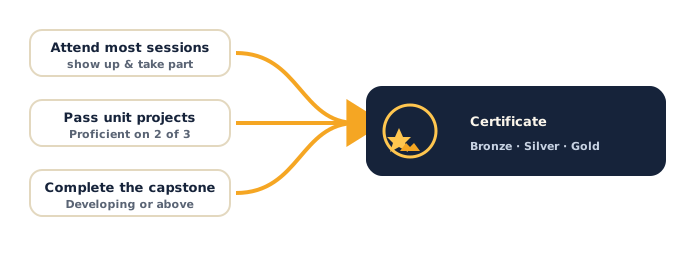
How a student earns the certificate
To earn the certificate, a student needs to do all three of these:
- Take part in most of the course — attend or complete at least 11 of the 14 sessions (Sessions 1–14). Missed sessions can be caught up with the homework.
- Show their skills on the unit projects — reach Proficient (3) or above on at least 2 of the 3 unit projects (Train Your Own AI, Data Detective Report, Invent & Pitch).
- Complete the capstone — finish the Build Something That Helps capstone at Developing (2) or above and present it at the showcase.
A student who meets all three earns the Course 1 Certificate: Young Builder.
Overall grade scale
The four rubric levels rise like a staircase:
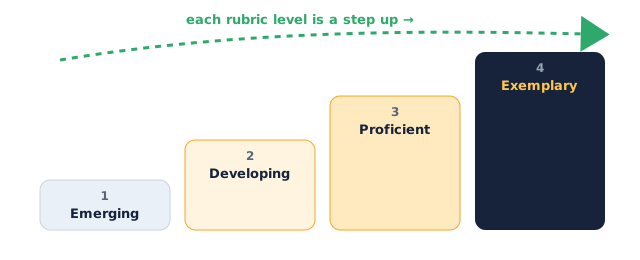
Add up the student's rubric scores from the three unit projects and the capstone. Each is scored out of 4 across 4 criteria, so each project is worth up to 16 points and the four projects together are worth up to 64 points. Use the total to award a level:
| Total points (out of 64) | Builder level | Also written as |
|---|---|---|
| 20–31 | Bronze Builder | Pass |
| 32–47 | Silver Builder | Merit |
| 48–64 | Gold Builder | Distinction |
A student below 20 points has not yet met the certificate bar — see the fairness note below on giving them a clear path to finish, rather than a "fail."
How to assess fairly
- Score the work, not the child. Judge what they made against the rubric words, not how confident or quiet they are.
- Best evidence counts. If a student improves a project after feedback, grade the improved version — this course is about learning, not first tries.
- Effort and honesty matter here. A model that "fails" but is tested honestly and explained well can still be Proficient — honest testing is a real skill in every rubric.
- Give the level, then one next step. Always pair a score with one specific, kind thing they could do better next time.
- Low-tech is not lower. A paper prototype or hand-drawn chart can score just as highly as a digital one — assess the thinking, not the tools.
- No child leaves empty-handed. A student who hasn't reached the bar gets a clear, short list of what to finish, plus a chance to redo one project. The goal is that everyone can become a Young Builder.
A note for students
Every builder starts somewhere. Bronze, Silver, and Gold are all real achievements — they show how far you pushed your own ideas. The best builders aren't the ones who never make mistakes; they're the ones who test honestly, fix what's weak, and keep going. Be proud of what you built.