
Unit 3 Project — Competition Entry
Run after: Sessions 9–12 · Time: 1–2 sessions (75 min each) · Ages: 12–15
Project goal: students take an earlier project, judge it against a real competition rubric, improve its weakest part, and present it as a polished written report plus a short live talk.
What students build
A competition-ready entry built from a project they already started (their Unit 1 predictor or Unit 2 research/build). It has two parts: a written report that others peer-review, and a live presentation to the class acting as judges. The goal is refinement — using feedback to make one real project genuinely better, not starting something new.
Example ideas:
- Turn the Unit 1 predictor into an entry: tighten the report, add a chart of accuracy, and make the fairness section a highlight.
- Turn the Unit 2 experiment or gadget into an entry: add a results graph, strengthen the limitations, and rehearse a demo of the Tinkercad circuit.
- Enter a real youth science fair or AI competition using this project as the draft submission.
Steps
- Read the competition rubric first. Know how judges score before you polish anything — clarity, evidence, originality, presentation.
- Score your own project against it. Be honest: which criterion is currently your weakest?
- Improve the weakest part. Spend most of your effort here — better evidence, a clearer chart, a stronger conclusion, or a cleaner explanation.
- Write the report with clear sections: Introduction, Method, Results, Discussion, Conclusion.
- Peer review. Swap reports with a partner. Each gives two things that work and two specific things to improve.
- Revise using the feedback and note what you changed.
- Prepare the presentation — a few slides and a 3–5 minute talk that a judge could follow without reading the report.
- Present and take questions from the class judges.
Deliverable
Two items submitted together:
- A written report (1–3 pages or a slide document) with labelled sections and at least one table or chart of evidence, plus a short note of what changed after peer review.
- A live presentation — 3–5 minutes of slides shown to the class, followed by questions.
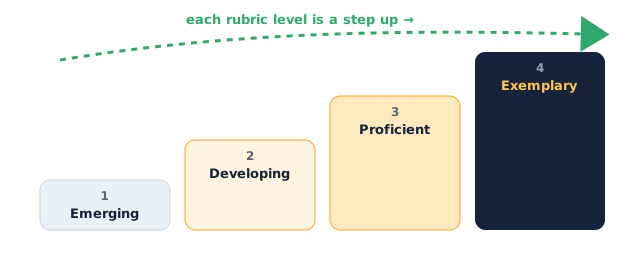
The rubric scores four rising levels:
Assessment rubric
| Criterion | Emerging (1) | Developing (2) | Proficient (3) | Exemplary (4) |
|---|---|---|---|---|
| Report clarity & structure | Hard to follow; sections missing | Has sections but uneven | Clear sections a stranger could follow | Polished, well-organised, reads like a real entry |
| Evidence presentation | No table or chart | Data shown but unclear | Clear table/chart that supports the claim | Evidence well-chosen and directly proves the point |
| Response to peer review | Ignored feedback | Minor changes, not from feedback | Made real changes based on feedback and noted them | Used feedback to fix the weakest part and explains the gain |
| Presentation delivery | Reads slides; unclear | Gets through it but hard to follow | Clear, paced, judge could follow without the report | Confident, engaging, handles questions well |
| Refinement & self-judgement | No self-assessment | Vague sense of what to improve | Identified the weakest part and improved it | Judged the project against the rubric and targeted the biggest win |
Instructor tips
- Timing: session one for self-scoring, improving the weak part, and drafting the report; session two for peer review, revision, and presentations. If you only have one session, do peer review and presentations and set the report as homework.
- Run peer review with structure. Give a simple form ("two strengths, two specific improvements"). Vague feedback like "it's good" is the main failure point — insist on specifics tied to the rubric.
- Play the judge. Ask one pointed question after each talk so students practise thinking on their feet.
- Differentiation: stretch students by having them peer-review two projects or add a live demo; support students with a report template and a slide skeleton so structure is handled and they focus on content.
- Low-tech fallback: reports can be handwritten and presentations given from a single poster or one shared screen. Peer review works perfectly on paper passed between partners.