
Course Capstone — Research & Innovation Project
Run after: Sessions 1–12 · Time: 2–3 sessions (75 min each), plus independent work · Ages: 12–15
Project goal: students plan and complete one substantial project — data science or engineering — from question to finished report and presentation, producing a portfolio piece worthy of a university application.
What students build
A full research or innovation project that pulls together everything from the course: a real question, a sound method, honest evidence, and a clear conclusion, delivered as a written report and a live presentation. This is the piece students will keep and show — to a competition, a teacher, or on a university application. It should be their best work, done over several sessions with time to revise.
Students choose their own direction. Two broad routes:
Data-science route — a prediction or analysis project in Colab: pick a meaningful dataset, ask a question, train and evaluate a model, and discuss fairness. A step up from Unit 1 in ambition and care.
Engineering route — an experiment or Arduino build in Tinkercad that solves a real problem with the sense–think–act idea, documented like a science paper.
Example ideas:
- Predict local air-quality or weather categories from an open dataset and discuss who a wrong prediction would affect.
- Investigate a real question with a rigorous fair test, many trials, and a graphed result.
- Build a Tinkercad safety gadget (flood sensor, gas alarm, plant-watering monitor) and document its design, testing, and limitations.
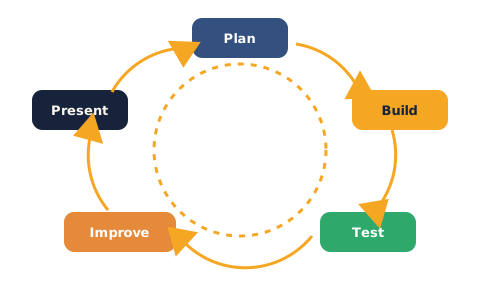
Your project moves through a cycle:
Steps
- Choose a question that matters to you. It should be answerable with data or a build, and specific enough to finish.
- Write a short proposal — your question, why it matters, your planned method, and what you will produce.
- Do background reading. Find one or two sources and cite them properly.
- Carry out the work — build and test the model (data route) or run the experiment / build the circuit (engineering route). Keep records as you go.
- Analyse honestly. Report accuracy, results, or measurements as they really are, with a chart or table.
- Write the full report with these sections: Abstract, Introduction, Method, Results, Discussion, Limitations, Conclusion, References.
- Peer review and revise. Exchange with a partner, take feedback, and improve the weakest section.
- Present — a 5-minute talk with slides, then questions.
A data-route project should test on unseen data and report the score plainly:
from sklearn.metrics import accuracy_score, confusion_matrix

predictions = model.predict(X_test)
print("Accuracy:", accuracy_score(y_test, predictions))
print(confusion_matrix(y_test, predictions))
# Report this honestly in the Results section — and say what it means.
Deliverable
A portfolio-ready package with three parts:
- A written report (2–5 pages or a full slide document) with all the labelled sections above, at least one chart or table of evidence, and proper references.
- The project artefact — the Colab notebook (data route) or the Tinkercad share link and results (engineering route).
- A 5-minute live presentation with slides, followed by questions.
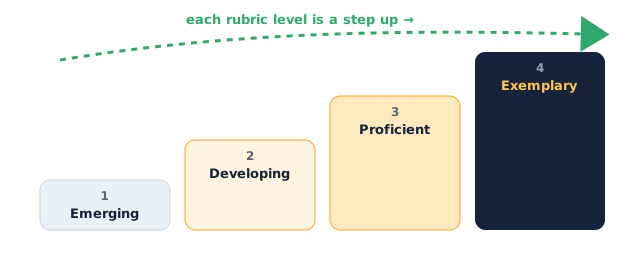
The rubric scores four rising levels:
Assessment rubric
| Criterion | Emerging (1) | Developing (2) | Proficient (3) | Exemplary (4) |
|---|---|---|---|---|
| Question & planning | No clear question or plan | Question present, weak plan | Clear question with a workable proposal | Original, well-scoped question with a thought-through plan |
| Method & rigour | Method unsound | Method present but gaps | Sound method: correct train/test or a controlled fair test | Rigorous, repeatable method others could reproduce |
| Evidence & analysis | Little or no evidence | Evidence shown, weak analysis | Clear evidence (chart/table) analysed correctly | Evidence well-analysed with correct, insightful interpretation |
| Report & references | Incomplete; no sources | Most sections; weak citations | Full sections with at least one proper citation | Publication-style report, well cited and well written |
| Honesty about limitations | None stated | Vague limitations | Real limitations that affect the result | Limitations analysed with concrete next steps |
| Presentation | Reads slides; unclear | Understandable but flat | Clear, paced, answers questions | Confident and compelling; handles hard questions well |
Instructor tips
- Timing: session one for proposals and background reading; session two for the core work; session three for report revision and presentations, with independent work between. Protect proposal time — a good question saves everything downstream.
- Approve proposals before students build. A five-minute check on each proposal prevents over-scoped or unanswerable projects.
- Insist on real evidence and honest limitations. The capstone rewards a correct, modest result far above an impressive-looking one that skips the method. Say this clearly at the start.
- Differentiation: stretch students with a second model comparison, a stronger literature note, or a live demo; support students with a report template, a starter notebook or circuit, and a shortlist of ready datasets or build ideas.
- Low-tech fallback: the engineering route can be an entirely offline fair-test experiment with a handwritten report and a poster presentation. A data-route student with no reliable internet can analyse a small printed dataset by hand and present the reasoning.
- Portfolio framing: remind students this is the piece they keep. Encourage them to save the report, the notebook or Tinkercad link, and the slides together so it is ready to show later.