
Session 6 — Read Like a Scientist
Duration: 75 min · Format: live online
What you'll learn: by the end, you can navigate the parts of a science paper, ask the three questions that test whether a source is trustworthy, and summarise and cite what you read.
Soft skill focus — Communication
Today you'll also grow Communication. Summarising a paper in one clear sentence and crediting your source is the core of scientific communication — taking something dense and making it honest and understandable to others.
- Try this: in the reading activity, compress the whole finding into a single plain sentence in your own words, then say it aloud — and treat a clean source line as part of communicating, not an afterthought.
- Think about: how would you explain what this paper found to a friend who hasn't read it — in one sentence?
What you'll need
- A kid-friendly article from Science Journal for Kids or Frontiers for Young Minds — you'll read the abstract first.
- Paper and a pencil (or a doc) ready to write a summary.
Hook
Think about this:
- If you read a headline that says "scientists say chocolate makes you smarter!" — should you believe it?
Here's the researcher's reflex: before believing anything, ask who said it, where, and what was the evidence. Today you become that careful reader — and stand on other scientists' shoulders.
Teach — Every science paper has the same parts
Once you know the map, any paper becomes readable — the parts are always in the same order.
Look at this diagram — notice each part:
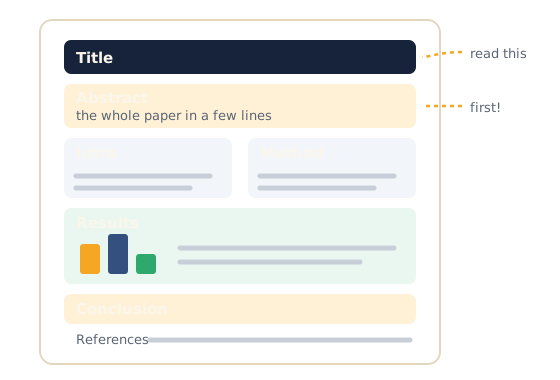
- Title — what it's about.
- Abstract — the whole paper in a few lines. Read this first!
- Introduction — why it matters + the question.
- Method — exactly what they did (so others can repeat it).
- Results — what they found (often charts).
- Conclusion — what it means.
- References — the sources they trusted.
Ask yourself: "If you only had 30 seconds with a paper, which part would you read? Why?" (Answer: the abstract — it summarises everything.)
Teach — Trust the source
Not everything online is true. Interrogate any claim with three questions:
- Who wrote it? (a scientist — or a random post?)
- Where was it published? (a journal or university — or a rumour?)
- What's the evidence? (data and a method — or just an opinion?)
⚠ Watch for the #1 misconception: it's tempting to think copying a fact and swapping a few words is fine. It isn't — when you use someone's idea you must cite it. Using others' work without credit is plagiarism, and it's a serious no-no.
Think about: take the chocolate headline from the hook — run it through the three questions. Does it pass?
Activity
Read a real article. Work through these moves on your own (or with a partner).
- Open a kid-friendly article on Science Journal for Kids or Frontiers for Young Minds.
- Read only the abstract first. What's the main finding, in one sentence?
- Skim the results (look at a chart). Does it support the abstract?
- Write down the source (title + where you found it) so you could cite it later.
Watch out for: is your finding a single plain sentence? Does the chart back it up?
Share it: read your one-sentence finding and your source line aloud. That source line is a citation — the habit real researchers never skip.
Check yourself
Try these — then check your answers:
- Which part of a paper should you read first? → The abstract — it summarises the whole paper in a few lines.
- Name one question that tests if a source is trustworthy. → Who wrote it? · Where was it published? · What's the evidence? (any one).
- What is plagiarism? → Using someone's words or ideas without giving them credit (without citing).
Wrap-up
- Name the three trust questions: Who? Where? What evidence?
- Try this at home — Summarise & cite: read one science article and write a 3-sentence summary in your own words, then add the source underneath (Author (Year), "Title", where). Bring it to Session 7.
Tips & extra challenges
- Watch out: it's easy to think "copying a fact and changing a few words isn't plagiarism." It still is — summarise in your own words, then always credit the source.
- Want more? Try this — write a one-page "mini-paper": turn the article you just read (or your own Session 5 experiment) into a real paper in miniature. Use this skeleton and aim for one page: Title (specific, not clickbait) → Abstract (3 sentences: question, what was done, what was found) → Intro (why it matters + the question) → Method (what was done, plainly) → Results (one finding, ideally with a number or a sketch of a chart) → Conclusion (what it means + one next question) → References (at least one source in the style Author (Year), "Title", where). Push two habits: write plainly (short sentences beat fancy words), and cite every claim that isn't your own. Then trade papers with a partner and check each other's: does the abstract match the results? Is every source cited? This is the exact structure your competition report will use in Unit 3.
Vocabulary
| Term | Meaning |
|---|---|
| Abstract | The paper's summary, read first |
| Source | Where information comes from |
| Citation | Naming the source you used |
| Plagiarism | Using work without credit |
| Peer review | Other scientists check the work |
Resources
- Frontiers for Young Minds — real papers, reviewed by kids, written for kids.
- Science Journal for Kids — real studies, simplified.
- Google Scholar — search real papers (with a grown-up).
Practice set
Practise on your own — extra exercises on paper parts, trusting sources, and citing, easy to hard. Answers follow each arrow.
- Which part? You have 30 seconds and want the paper's main finding. Which part do you read? → The abstract — it summarises the whole paper in a few lines.
- Match the part. Where would you look to repeat the experiment exactly? → The Method — it lists precisely what the researchers did.
- Trust check. A post on a random social-media account says "eating chocolate cures colds — trust me." Run the three questions (Who? Where? What evidence?). Does it pass? → No on all three: no named expert, no journal or institution, no data or method — just a claim.
- Spot the flaw in this source. A website selling vitamin pills has an article titled "Studies prove our pills boost memory," but names no study and links to nothing. What's the problem? → The seller has a reason to be biased, and there's no evidence you can check — an unlinked "studies prove" is not a source.
- Plagiarism or okay? A student copies a sentence from a paper, changes three words, and doesn't mention the paper. Plagiarism? → Yes — swapping a few words is still using someone's work without credit. Summarise in your own words and cite it.
- Fix the citation. A student writes their source as just "I read it online." Rewrite it properly. → Use the style Author (Year), "Title", where — e.g., Lee (2022), "How Sleep Helps Memory", Science Journal for Kids.
- Design a check (harder). You find two articles that disagree about whether video games improve reflexes. How do you decide which to trust? → Compare them on the three questions: which has the more qualified authors, the more reputable place of publication, and the stronger evidence (a real study with a method and sample size vs. an opinion). Prefer the one with checkable data; note if either is trying to sell something.
Going deeper (optional)
If you're ready to go past "is this source good?", here's more.
Peer review — the science filter. Here's what really happens before a paper is published: the authors send it to a journal, which passes it to other independent scientists (the authors' "peers") who try to find mistakes, weak methods, or overblown conclusions. Only if it survives that scrutiny does it get published. That's why a peer-reviewed journal article outranks a random blog — it's already been attacked by experts and held up. Tie it to the three trust questions: peer review is the strongest possible answer to "Where was it published?" And even peer-reviewed work can later be corrected — science self-corrects, which is a feature, not a flaw.
Primary vs. secondary sources. A primary source is the original study — the scientists who ran the experiment reporting their own results. A secondary source is a news article about that study. Here's why the game of "telephone" matters: a careful headline can still distort a study ("linked to" becomes "causes"). Trace a bold news claim back to the primary paper whenever you can — the abstract of the original almost always says something more careful than the headline.
Common mistakes & fixes
- Mistake: Reading a paper top-to-bottom and giving up in the dense middle. → Fix: Read the abstract first, then skim results/charts; dive into the method only if you need the details.
- Mistake: Trusting a claim because it "sounds sciencey" or has big numbers. → Fix: Run the three questions — Who? Where? What evidence? A confident tone is not evidence.
- Mistake: Copying a sentence and changing a few words, thinking that avoids plagiarism. → Fix: Summarise in your own words, then cite the source — rewording someone's idea still needs credit.
- Mistake: Confusing correlation in a study with proof of cause (headlines love this). → Fix: Check whether the study actually ran a controlled test; "linked to" or "associated with" usually means not proven to cause.
- Mistake: Writing a vague citation like "from the internet." → Fix: Record enough to find it again — Author (Year), "Title", where — the moment you use the source, before you forget it.
What's next
Session 7 — Hello, Hardware! you'll build a real electronic circuit in a free simulator and write Arduino code to make an LED blink.