
Session 9 — Enter the Arena
Duration: 75 min · Format: live online
What you'll learn: by the end, you can match your project to a real competition, read a judging rubric, self-score honestly, and write a one-page entry plan naming what to improve first.
Soft skill focus — Teamwork
Today you'll also grow Teamwork — choosing an arena and scoring a rubric go faster and more honestly when a classmate pressure-tests your judgement.
Try this: when you self-score, pair up with a classmate and challenge each other's rows. A teammate who asks "why a 3 and not a 5?" keeps you honest and catches blind spots you'd miss on your own.
Think about: what did a classmate spot in your project that you'd missed on your own?
What you'll need
- The rubric diagram below — you'll use it to score your project.
- One real competition page open in a tab (e.g. ISEF or Technovation) so you can look at a real rubric or rules page.
- The project you built in Unit 2 open or nearby, plus paper for scoring.
Hook
Ask yourself:
- When do you work hardest on something — with no deadline, or with a real one coming up?
- If you had to show your project to strangers next month, what would you fix first?
Here's the point: a competition gives a project three things a school assignment usually lacks — a goal, a deadline, and an audience. That combination is exactly what turns a rough build into something finished. This final block is about preparing your project for a real stage.
Teach — Find your arena
There's a competition for almost every skill you've learned this course:
- Science fairs (ISEF, regional fairs) — for experiments and research.
- Robotics leagues (FIRST, VEX) — for engineering and Arduino builds.
- Hackathons & Kaggle — for coding, data, and AI.
- App challenges (Technovation) — for solving a real problem with tech.
⚠ Watch out for the "I need a brand-new idea" trap: you might think you have to start over with something more impressive. You don't — the gadget, model, or data project you already built is a perfect entry. Your work now is refining it to fit a competition, not replacing it.
Which of these arenas fits the project you built in Unit 2? Name the competition type — and if you're not sure, match your project to the category it's strongest in.
Teach — Judges score with a rubric
Winning is not luck. Judges score every entry against a rubric — a scorecard with fixed criteria. If you know the rubric, you know exactly what to aim for.
Here's what one looks like:
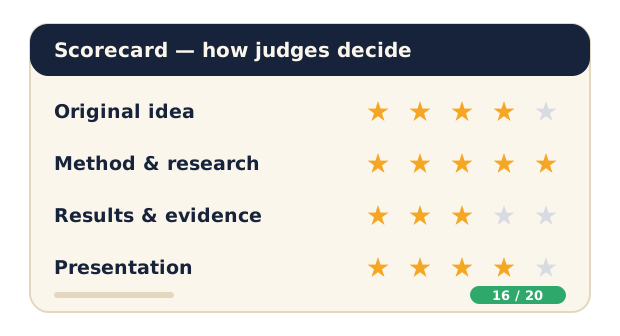
The four typical rows are:
- Original idea — is it creative and useful?
- Method & research — was it tested properly?
- Results & evidence — do the data back it up?
- Presentation — can it be explained clearly?
The key idea: get the rubric first, then build to score high on every row. Most people forget presentation — a great project explained badly loses to a good one explained well.
Think about: if a project has amazing results but a confusing, crashing demo, how does it score? It loses points on the presentation row — judges can only reward what they can understand.
Activity — Self-score + entry plan
Work on your own project.
Part 1 — Self-score (≈15 min).
- Choose the competition type that fits your project.
- Find its judging criteria (or use the four-row rubric above).
- Self-score your current project out of 5 on each row — honestly.
- Circle your two weakest rows. Those are next session's targets.
As you score, ask yourself: "Why did I give that row a 3 and not a 5? What one change would move it up?" Be honest — a self-score of all 5s usually means you aren't looking hard enough.
Part 2 — One-page entry plan (≈15 min).
Write your plan on one page: which competition, the deadline, your project, and the top 3 things to improve before then.
When you're done, read your weakest row and your #1 fix out loud (to a classmate or the group). You now know exactly what to work on — that clarity is the whole point of a rubric.
Check yourself
Try answering these, then check yourself against the arrows:
- What is a rubric? → A scorecard judges use — the exact criteria your project is scored on.
- Why get the rubric before you build (or refine)? → So you can aim to score high on every criterion instead of guessing what judges want.
- Which criterion do people most often neglect? → Presentation — a great project explained badly loses to a good one explained well.
Wrap-up
- Finish the sentence: "The competition I'm aiming for is… and my weakest row is…"
- Try this at home: find the official rules for a real competition that fits your project (word limits, materials allowed, safety forms, deadline). Bring one rule that surprised you to Session 10.
Tips & extra challenges
- Watch out: don't fall for "I need a new, more impressive idea." Refine what you already built to fit the rubric.
- Want more? Try this — run a full "entry audit": treat your project as a real submission and build the complete package. (1) Find the actual rubric for your target competition and score every row 1–5 with a one-line justification each. (2) Write a backward timeline from the real deadline — mark what must be finished each week, plus any hard gates (registration close, safety-form due date, mentor sign-off). (3) Draft a one-paragraph entry pitch (problem, what you built, result, why it matters) as if it were the submission summary. (4) List every rule constraint that affects your project (word limits, allowed materials, team size, originality) and flag anything you currently violate. This is a genuine project-management artefact, not busywork.
Vocabulary
| Term | Meaning |
|---|---|
| Competition | An event where projects are judged |
| Rubric | The scorecard judges use |
| Criteria | The things you're scored on |
| Deadline | When it must be finished |
| Entry / Submission | The project you send in |
Resources
- Society for Science — ISEF — the world's largest pre-college science fair.
- Technovation Girls — build an app that solves a real problem.
- Kaggle Competitions — data-science challenges (start with "Getting Started").
Practice set
Practise on your own — each one sharpens reading a rubric, matching a project, and planning an honest entry. Model answers follow the arrow.
- Match the arena. A student trained a small image classifier to sort recycling photos. Which competition type fits best, and why? → A hackathon or a data/AI challenge (e.g. Kaggle-style) — the core is a working model on real data. A science fair also works if they frame it as an experiment with results; pick the arena that rewards what their project is strongest at.
- Score honestly. A project has a clever idea and great results, but the report has no method section and the demo crashes half the time. Score the four rows out of 5. → Roughly Original idea 4–5, Method 2 (not repeatable — no method written), Results 4, Presentation 2 (crashing demo). The two weak rows to target are Method and Presentation.
- Spot the neglected row. A team says "our project is amazing, we don't need to practise explaining it." Which rubric row are they about to lose? → Presentation — judges can only reward what they can follow; an unexplained project scores low even with strong results.
- Improve the plan. A one-page plan says: "I'll enter a competition and try to win." Rewrite it so it is useful. → Name the specific competition, the exact deadline, the project, and the top 3 fixes (e.g. "add a titled results chart, write the method so it's repeatable, rehearse a 3-min demo"). A plan without named targets can't guide the work.
- Read the rule. A robotics contest rule says "no pre-built kits for the main mechanism." A student's entry uses a pre-built gripper as its core. What must change? → The core mechanism must be their own build — they either replace the gripper with one they design, or move to a competition that allows kits. Read rules before refining, not after.
- Pick the first fix. A self-score reads: Idea 5, Method 5, Results 3, Presentation 2. Where should the student spend next session, and why? → Presentation first (the 2), then Results (the 3) — attack the lowest rows for the biggest gain; a 5 can't rise, but a 2 has the most room.
Going deeper (optional)
Optional — for classes ready to go further.
Reading a real rubric line by line. Pull up the actual judging criteria from your target competition (ISEF, Technovation, a local fair) and read one row closely. Real rubrics are more detailed than our four rows — they often split "presentation" into poster/slides, spoken clarity, and answers under questioning, and they attach point weights (e.g. method might be worth 30 points, presentation 20). Notice two things: first, where the points actually are — you optimise for the heaviest rows, not the ones you enjoy most; second, the exact wording, because judges reward the words on the sheet. If the rubric says "demonstrates understanding of the underlying science," a slick demo alone won't score — you have to explain the why.
The deadline as a design tool. Professionals use a deadline backward. Take a real date six weeks out and build your timeline: final week is rehearsal and backups only; the week before is the finished report; before that, results locked; before that, the last build changes. A deadline doesn't just add pressure — it tells you what to stop doing and when. A project that is still adding features the night before almost always presents worse than one that froze early and rehearsed.
Common mistakes & fixes
If it's not working, check these:
- Mistake: Thinking you need a brand-new, more impressive idea to enter. → Fix: The project you already built is a valid entry — the work is refining it to the rubric, not starting over.
- Mistake: Self-scoring every row a 5. → Fix: If nothing is weak, you aren't looking hard enough; write a one-line justification per row and defend any 5.
- Mistake: Building first, then hunting for the rubric. → Fix: Get the rubric first so every improvement aims at a scored criterion instead of guessing.
- Mistake: Neglecting the presentation row because the "real work" is the results. → Fix: Judges reward only what they understand; a great project explained badly loses to a good one explained well.
- Mistake: Writing a vague plan ("try my best, aim to win") with no named competition or deadline. → Fix: Name the competition, the exact deadline, and the top 3 fixes — a plan without targets can't steer the work.
What's next
Session 10 — Polish Your Project: you'll take your project from "it works" to "it shines," targeting your weakest rubric rows.