
Session 11 — Write It Up & Peer Review
Duration: 75 min · Format: live online
What you'll learn: by the end, you can write your project's story in a clear five-part report, run a structured "two stars and a wish" peer review, and revise your own report using what you heard.
Soft skill focus — Communication
Today you'll also grow Communication — a report only counts once a stranger can follow it, and feedback only helps once it names the exact thing to change.
Try this: in the peer-review round, ban vague praise from yourself — point to the specific part that works and give one concrete, kind fix.
Think about: which part of your report was hardest to say plainly, and how did you fix it?
What you'll need
- The peer-review diagram below to look at.
- A partner to swap reports with (your instructor will pair you up).
- Your polished project from Session 10 and a doc to write in.
Hook
Think about these for a moment:
- If you discovered something amazing but no one could follow your explanation, did it really count?
- Who checks a scientist's work before the whole world sees it?
Here's the point: even a brilliant result is useless if no one can follow — or repeat — it. Great builders write so clearly a stranger could redo their work, and real scientists review each other before publishing. You'll practise both skills today.
Teach — Your report tells the story
Use the same structure real papers use — the one you met back in Unit 2. Here are the five sections:
- Problem / Question — what you set out to solve.
- Method — exactly what you did (so it's repeatable).
- Results — what you found, with a chart or numbers.
- Conclusion — what it means, plus limitations.
- References — your sources, cited.
The key: write plainly and honestly — short sentences win. Include what didn't work too; that's what makes a report trustworthy.
⚠ Watch out — don't hide the failures: it's tempting to think a report should only show wins, so you delete the parts that went wrong. Don't. Honest limitations make your work more credible, and judges respect them.
In one sentence, what problem did your project solve? Say it plainly — and if it comes out vague, tighten it until a stranger would understand.
Teach — Peer review makes it stronger
Scientists check each other's work before the world sees it — and today you'll do the same, kindly and usefully.
Here's the frame to use:
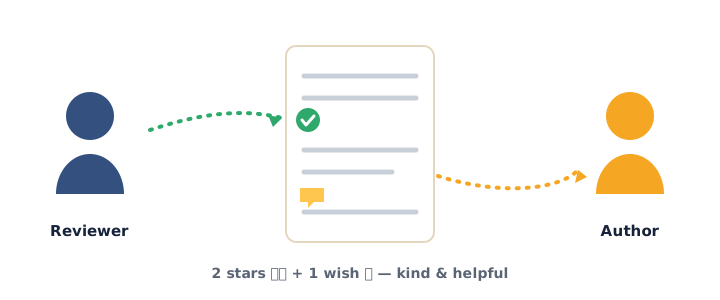
The "Two stars and a wish" frame:
- Two stars — two things that genuinely work well.
- One wish — one specific, kind suggestion to improve.
The key: good feedback is specific. Not "it's nice," but "your chart is clear — adding a title would make it even better."
Picture this: someone tells you "good job, I liked it." Can you improve anything from that? Not really — it isn't specific. Useful feedback names the exact thing and a concrete fix.
Activity — Write, then two stars and a wish
Part 1 — Write the report (≈12 min). Write (or finish) your report using the five sections. Check that every section is present and that your method is repeatable — could a stranger follow it exactly?
Part 2 — Run the peer-review round (≈18 min). Here's how it works:
- Pair up with a partner (your instructor will sort this out, in a breakout room or the main room).
- Swap reports. Take 3–4 minutes to read silently — no talking yet. Reading first stops you from reacting off the top of your head.
- Your instructor will model one example first: listen to how a specific, kind two-stars-and-a-wish sounds before you try it yourself.
- One of you gives feedback first, then swap. Stick to the structure: exactly two stars (name the specific thing that works) and one wish (one concrete, kind suggestion). Give it about 3 minutes each direction.
- No vague praise, no "fix everything." If you catch yourself saying "it's good," push further: good how — point to the exact part. Keep it to one wish so it's actionable, not overwhelming.
- Write down the two stars and the wish you received before you leave the pair.
As you review, keep coaching your own tone: specific, kind, and one clear improvement.
Reflect: what wish did you receive, and what will you change because of it? This is exactly how real science improves.
Check yourself
Try to answer these before you peek — the answer follows each arrow.
- What are the main sections of a report? → Problem → Method → Results → Conclusion → References.
- What is "two stars and a wish"? → Two things done well, plus one specific, kind suggestion to improve.
- Should a report include what didn't work? → Yes — honest limitations make the work trustworthy, and judges respect it.
Wrap-up
- Name the single biggest improvement your partner's wish pointed to.
- Try this at home: revise your report using your partner's feedback and write one sentence naming the biggest change you made. That's the peer-review loop in action. Bring the revised report to the final showcase.
Tips & extra challenges
- Watch out: it's a myth that a report should only show what worked. The opposite is true — honest limitations build trust.
- Want more? Try this — write a full research paper and review a partner's like a journal: raise the bar from a five-part report to a real paper. (1) Add an Abstract (4–6 sentences: problem, method, key result, what it means) and an Introduction that says why the problem matters. (2) Expand your Conclusion into a Discussion plus an honest, separate Limitations section naming where the work could be wrong. (3) Cite every source in one consistent style and summarise each in your own words — never copy. (4) Then swap papers and run a rigorous-but-respectful review: check whether the method is truly repeatable, question whether the evidence supports each claim, and write three specific, concrete fixes (not "make it better"). Your deliverable is a paper plus a written reviewer's note your partner could actually act on.
Vocabulary
| Term | Meaning |
|---|---|
| Report / Paper | The written story of your project |
| Peer review | Colleagues checking your work |
| Feedback | Comments to help you improve |
| Revise | Improve a draft |
| Limitations | Where your work could be wrong |
Resources
- Google Docs — write and share your report; use comments for review.
- Purdue OWL — how to cite — simple citation help.
- Frontiers for Young Minds — see how real papers are written and reviewed.
Practice set
Practise on your own — each of these reinforces clear report sections, honest writing, and specific peer feedback. Model answers follow the arrow.
- Improve a weak abstract. "My project is about AI. I did some tests and it worked well. It was cool." Rewrite it. → Name the specifics: "I built an image classifier that sorts recycling photos into three bins. I trained it on 300 labelled photos and tested it on 60 new ones; it was correct 82% of the time. This could speed up sorting, though it struggles with dirty items." A good abstract states the problem, method, a real result, and what it means.
- Fix vague feedback. A reviewer says "Two stars: it's good and I liked it. Wish: make it better." What's wrong, and give a specific version. → Nothing is actionable. Better: "Stars: your results chart is clear, and your method lists every step. Wish: your conclusion doesn't mention limitations — add one sentence on where it might fail." Good feedback names the exact part and a concrete fix.
- Match the section. Which report section does this sentence belong in — "I placed the sensor 10 cm away and took 5 readings"? → Method — it's exactly what was done, written so it's repeatable.
- Rescue a hidden failure. A student deletes the part where their model failed on blurry photos so the report "looks better." Coach them. → Put it back, in Limitations — honest limitations make the work more credible, and judges respect them. Hiding failures makes a report less trustworthy, not more.
- Turn a wish into an action. A student received the wish: "Your method is hard to follow." What's the concrete next step? → Rewrite the method as numbered, exact steps a stranger could repeat — distances, counts, settings — and have someone else read it back to check nothing is missing.
- Cut the vague claim. "The results were amazing and prove my idea is the best." Tighten it to something a judge would trust. → "The model was correct 82% of the time on 60 unseen photos — better than guessing (33%), though not yet reliable enough for real use." Replace superlatives with numbers and honest scope.
Going deeper (optional)
Optional — for classes ready to go further.
Why "two stars" comes before "a wish." It looks like a politeness rule, but there's real craft in it. Leading with two specific stars does two jobs: it tells the writer exactly which parts to keep and not accidentally cut, and it earns enough trust that the wish actually gets heard instead of triggering defensiveness. Push yourself past generic praise — "it's nice" keeps nothing; "your labelled chart makes the result obvious at a glance" tells the writer precisely what's working. Finding two genuine, specific strengths in every project is itself a skill; a reviewer who can only find faults isn't a better critic, just a less useful one.
Limitations as a strength, not a confession. It's easy to assume admitting a weakness loses points. In real science, the opposite is true. A limitations section proves you understand your own method well enough to see its edges — "this was tested on only 60 photos, all taken indoors, so it may not generalise to outdoor lighting" tells a judge you think like a scientist. Compare that to a report that claims a perfect result with no caveats: an experienced judge immediately distrusts it, because no real experiment is that clean. The move to practise: after every claim, ask "when would this not be true?" and write that down.
Common mistakes & fixes
If it's not working, check these:
- If you deleted the parts that went wrong so the report "looks better" → Honest limitations build trust; put your failures in a Limitations section — judges respect them.
- If your feedback is vague like "good job, I liked it" → Name the exact part that works and one concrete improvement; unspecific feedback can't be acted on.
- If your method is too vague to repeat ("I tested it and it worked") → Number the exact steps — distances, counts, settings — so a stranger could redo it.
- If you copied source text or facts without citing or rewording → Summarise in your own words and cite every source; copying is neither honest nor a report.
- If you piled on many wishes and overwhelmed the writer → Keep it to one clear, actionable wish so the improvement actually happens.
What's next
Session 12 — Showtime!: the grand finale — you present your project to a panel, handle questions, and complete your portfolio.