
Unit 2 Project — Research & Build
Run after: Sessions 5–8 · Time: 1–2 sessions (75 min each) · Ages: 12–15
Project goal: students investigate a question like a scientist — either by designing a fair experiment or by building a sensing Arduino gadget — and document it with a method, results, and honest limitations.
What students build
Students choose one of two tracks and produce a short scientific write-up for it. Both tracks are graded on the same thing: clear method, real evidence, and honesty about what went wrong.
Track A — Design a fair experiment. A written experiment with one variable changed, everything else kept the same, and results recorded in a table or Google Sheet.
Track B — Build a smart gadget. An Arduino circuit built in Tinkercad that follows the sense–think–act loop: read a sensor, decide with an if/threshold, act with an output.
Example ideas:
- (A) Does the shape of a paper plane change how far it flies? Change only the wing fold; keep paper, launch force, and height the same; measure distance over five throws each.
- (A) Does water temperature change how fast sugar dissolves? Change only temperature; keep amount of sugar and stirring the same.
- (B) A night-light that turns an LED on when a light sensor reads below a threshold (sense light → think "is it dark?" → act by lighting the LED).
- (B) A "too hot" alarm that sounds a buzzer when a temperature sensor crosses a set value.
Steps
- Choose a track and write your question. State exactly what you want to find out in one sentence.
- Make a prediction (hypothesis). Say what you think will happen and why.
- Plan the method. Track A: name the one variable you change, the things you keep the same, and what you measure. Track B: plan your sense–think–act loop — which sensor, what threshold, which output.
- Run it. Track A: carry out the experiment and repeat each condition several times. Track B: build and wire the circuit in Tinkercad and test it at different sensor values.
- Record results. Put numbers in a table or Google Sheet (Track A) or describe what the gadget did above and below the threshold (Track B).
- State your conclusion. Answer your question using your evidence — did the results match your prediction?
- Write your limitations. Name at least two things that could have gone wrong or made the result less reliable.
A Track B threshold decision in Arduino C++ looks like this:
int reading = analogRead(A0);   // sense
if (reading < 300) {            // think: is it dark enough?
  digitalWrite(13, HIGH);       // act: turn the LED on
} else {
  digitalWrite(13, LOW);
}
Deliverable
A 1–2 page scientific write-up (a document or slides) with these labelled sections: Question, Hypothesis, Method, Results, Conclusion, Limitations. Attach the evidence:
- Track A: the results table or a link to the Google Sheet.
- Track B: the Tinkercad share link to the working circuit and a note of the threshold value used.
The rubric scores four rising levels:
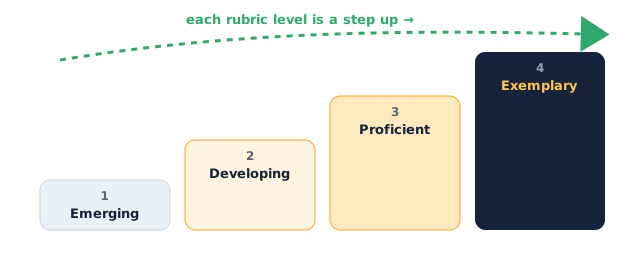
Assessment rubric
| Criterion | Emerging (1) | Developing (2) | Proficient (3) | Exemplary (4) |
|---|---|---|---|---|
| Question & hypothesis | Missing or unclear | Question stated, no reasoning | Clear question with a reasoned prediction | Prediction is specific and justified with prior knowledge |
| Method / fair test | No real method | Method vague; variables not controlled | Changes one thing, keeps others the same (A) or clear sense–think–act plan (B) | Method is repeatable and someone else could follow it exactly |
| Evidence & results | No results recorded | Results present but messy or unrepeated | Results in a clear table/link; repeated or tested at several values | Results organised, repeated, and easy to read at a glance |
| Conclusion from evidence | No conclusion | Conclusion not backed by results | Conclusion answers the question using the evidence | Links result back to the hypothesis and explains why |
| Limitations & honesty | None given | One vague limitation | Two real limitations that affect reliability | Limitations named with a concrete way to improve next time |
Instructor tips
- Timing: session one for question, hypothesis, and method (and building the Tinkercad circuit); session two for running, recording, and writing up. In a single session, have Track A students plan and run a quick experiment and Track B students build from a starter circuit.
- Let the two tracks coexist. Group Track A and Track B students separately so you can circulate. The rubric is deliberately shared so grading stays fair across both.
- Differentiation: stretch students by asking for more trials, a graph of the results, or a second threshold; support students by giving Track B a pre-wired Tinkercad starter to modify and Track A a ready-made results table to fill in.
- Reward honesty about limitations. This is the section students skip. Model it: show them a "perfect" result and ask "what could have made this wrong?"
- Low-tech fallback: Track A needs no computers at all — run it with everyday materials. For Track B without reliable internet, sketch the sense–think–act circuit on paper and trace what happens above and below the threshold by hand.