
Certificate & Assessment Criteria
How a Course 2 — The Rising Builders (ages 12–15) student earns their certificate: the completion gate, turning rubric points into an overall grade, and assessing research and builds fairly.
This page tells instructors how a Course 2 — The Rising Builders student earns the course certificate, how to turn rubric points into an overall grade, and how to assess fairly. It is a reference, not a session.
How a student earns the certificate:
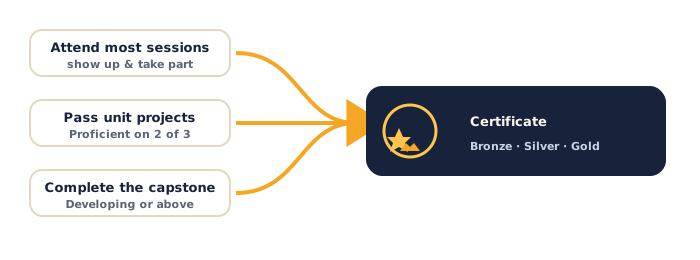
How a student earns the certificate
To be awarded the Course 2 certificate, a student must meet all three of these:
- Attendance & participation — complete most of the 14 sessions (a minimum of 11 of 14). Students who miss more should catch up on the project work before certification.
- Unit projects — reach Proficient (3) or higher on at least 2 of the 3 unit projects (Unit 1 — Build a Predictor, Unit 2 — Research & Build, Unit 3 — Competition Entry).
- Capstone — complete the Course Capstone at Developing (2) or higher, with a written report and a presentation.
A student who meets all three has earned the certificate. Use the grade scale below to decide the level of the award.
Overall grade scale
The four rubric levels rise like a staircase:
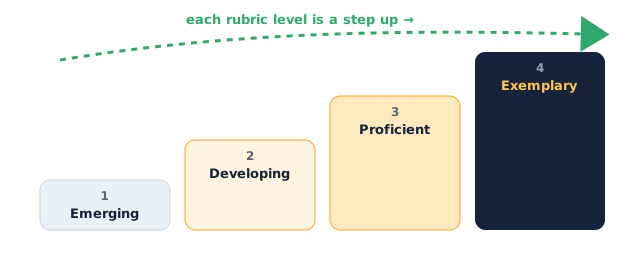
Add up the student's rubric level on each of the four graded projects (three unit projects + capstone). Each project is scored on its own rubric; take the average rubric level per criterion for each project, then combine.
For a single project, average its criterion scores to one number out of 4. Then average the four project scores to a final figure out of 4, and map it:
| Final average (out of 4) | Award |
|---|---|
| Below 2.0 | Not yet certified — revise and resubmit |
| 2.0 – 2.5 | Pass — certificate awarded |
| 2.6 – 3.3 | Merit — certificate with Merit |
| 3.4 – 4.0 | Distinction — certificate with Distinction |
The certificate requirements above are the gate; this scale sets the level. A student can meet the gate at Pass and still be certified. Distinction should reflect consistently strong method, evidence, and honesty across projects — not a single standout piece.
Portfolio & university-readiness
Course 2's projects are deliberately portfolio pieces. The unit projects and especially the capstone are real, evidenced work a student can show to a competition judge, a teacher, or on a university or scholarship application. Encourage every student to keep, in one place:
- the capstone report (with references),
- the Colab notebook or Tinkercad share link behind it,
- the presentation slides.
Remind students that admissions and competitions value honest, rigorous work — a modest result done properly, with clear limitations, is stronger evidence of a real researcher than an impressive claim with no method behind it.
How to assess fairly
- Grade the method, not the outcome. A correct train/test split with a 70% score beats an unexplained 95%. Reward sound process and honest reporting.
- Use the rubric, criterion by criterion. Score each row on its own evidence rather than forming one overall impression. This keeps grading consistent between students and between the two Unit 2 tracks.
- Value honesty about limitations. Students who name what went wrong should never score below those who hide it. Make this explicit before projects begin.
- Judge the two tracks on the same bar. Unit 2's experiment and build tracks share one rubric on purpose — hold both to the same standard of method, evidence, and honesty.
- Account for starting points. Note growth across the three unit projects; a student who improves visibly by the capstone is demonstrating exactly what the course teaches.
- Give the reason for the score. When you return a grade, name the one criterion that would most raise it next time. Feedback should point to the rubric, not to the person.