
Session 5 — Be a Data Detective
Duration: 60 min · Format: live online
What you'll learn: by the end, you can say what data is, write a clear and fair survey question, and collect answers using tally marks.
Soft skill focus — Curiosity
Today you'll also grow Curiosity. A data detective is really just a curious person who wonders "what would happen if I actually counted?"
Try this: before you run your survey, say what you're curious to find out — the gap between your hunch and the real tally is what makes collecting the data exciting.
Think about: What did your data make you curious to find out next?
What you'll need
- Paper and a pencil for your own tally sheet.
- Optional: a device to open Google Sheets for the extension.
Hook
Let's count a couple of things:
- How many windows are in the room you're sitting in right now? Count them.
- How many people live in your home?
Those numbers you just counted are data. Data is simply information we collect — numbers, answers, and facts. Today you become a data detective.
Teach — What is data?
Here's the key idea:
- Data = pieces of information we gather.
- Examples: today's temperature, everyone's favourite colour, the goals scored in a match.
- When you collect lots of data and look at it together, you can discover answers.
⚠ Watch out for the mix-up: it's easy to think data has to be a number. Data can also be words and facts (a favourite colour, a yes/no answer) — not just numbers.
Name one piece of data about you right now — your age, your favourite game, how many pets you have.
Teach — Surveys collect data
A survey is when you ask the same question to many people and write down every answer. Here are the three fairness rules:
- Give simple choices — like 3 options, not twenty.
- Ask enough people — not just your best friend.
- Write down every answer — even the ones you didn't expect or don't like.
Look at this diagram — a survey of "What's your favourite fruit?", where each block is one vote:
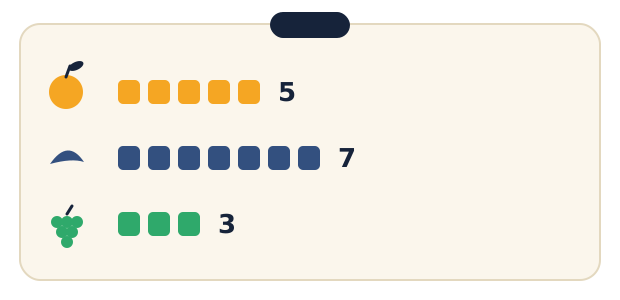
Apple = 5 · banana = 7 · grapes = 3.
Which fruit got the most votes? Which got the fewest? (Banana most with 7; grapes fewest with 3.)
Activity — Make your own survey
Design and run a mini survey.
- Pick a fun question (e.g. favourite animal, colour, or game).
- Choose exactly 3 answer choices.
- Ask 8–10 people (family, or classmates) and make a tally mark for each answer.
- Count the totals.
The tally trick: draw one line per vote, and cross out every 5th — this makes them easy to count in groups of five.
As you go, check that your choices are simple and that you're recording every answer, not only the ones you like.
You just collected and organised real data — exactly what a data scientist does first.
Check yourself
Try to answer these, then check yourself after the arrow.
- What is data? → Information we collect — numbers, answers, or facts.
- What makes a survey fair? → Clear choices, asking enough people, and writing down every answer.
- In the fruit survey, which fruit won? → Banana, with 7 votes.
Wrap-up
- Finish this sentence in your own words: "Data is…"
- Try this at home — Detective's guess: before you ask anyone, secretly write down who you think will win your survey and hide it. Then run your survey with at least 10 people, reveal your guess, and see if you were right. Keep your tally sheet safe — next session we turn it into a chart!
Tips & extra challenges
- Watch out: it's easy to think "data is only numbers." Really it's any information we collect, including words and yes/no answers.
- Want more? Try this: learn about tables — real datasets live in tables where rows are records (one per person) and columns are the facts (name, age, score). Open Google Sheets and type your survey as one row per person with columns like
NameandFruit. Mini-challenge: collect two facts per person (e.g. favourite fruit and age) to make a mini-dataset, then answer one question that needs both columns — like "What fruit do the oldest kids like?" Sort the sheet by theAgecolumn (Data → Sort range) and read off the answer. Bonus: predict the answer before sorting, then check. Explore friendly real datasets on Google Dataset Search.
Vocabulary
| Term | Meaning |
|---|---|
| Data | Information we collect |
| Survey | Asking many people the same question |
| Tally | A mark for counting each answer |
| Sample | The group of people you asked |
| Fair | Not tricking the result |
Resources
- Google Sheets — a place to type your data into rows and columns.
- Our World in Data — see real data about the whole world (with a grown-up).
- Census At School — fun data activities for kids.
- Google Dataset Search — explore friendly real datasets (extension).
Practice set
Practise on your own — these build from easy to hard on data, surveys, and tallies, and the answer comes after the arrow.
- Data or not? Which of these are pieces of data: the number 7, your favourite colour, a smell you can't describe, how many pets you have? → The number 7, your favourite colour, and how many pets are all data (numbers, words, and facts). A smell you can't put into words yet isn't recorded information.
- Read the tally. A tally shows apples
||||, bananas|||| ||(that's 5 then 2), oranges|||. How many votes did each get, and which won? → Apples 4, bananas 7, oranges 3; bananas won. - Fix the unfair question. Why is "You love football, don't you?" a bad survey question? → It pushes people toward one answer. A fair version: "Which sport do you like best: football, swimming, or basketball?"
- Design a fair one. Write a survey question with exactly 3 simple choices about favourite ice-cream flavour. → Example: "What's your favourite ice-cream: chocolate, vanilla, or strawberry?" — three clear choices.
- Spreadsheet task. In Google Sheets, make a table with columns
NameandPetand type in 5 classmates as 5 rows. How many rows and columns is that (not counting the heading row)? → 5 rows, 2 columns. - Sample size (hard). Maria asked only her 2 best friends "best game?" and both said chess, so she says "everyone loves chess." What's wrong, and how many should she ask? → Her sample is too small and not fair; she should ask 8–10 different people before deciding.
Going deeper (optional)
Optional — if you're flying. Learn the idea of an open vs a closed question, because it changes how easy the data is to count. A closed question gives fixed choices ("apple, banana, or grapes?") — easy to tally because every answer lands in one of your boxes. An open question lets people say anything ("what's your favourite fruit?" with no list) — you get richer answers but a messy pile that's hard to count, because one person says "banana," another says "bananas," another says "the yellow one." Try a quick test: ask one open question and see how many different spellings and words come back for the same thing. Then ask the same question as a closed one with 3 choices. The lesson: closed questions make data easy to count; open questions need tidying up first. This quietly sets up next session's chart work and the "cleaning" idea later in the block.
Common mistakes & fixes
- Mistake: thinking data must be a number, so you don't count "favourite colour" as data. → Fix: remember data is any information we collect — words and yes/no answers count just as much as numbers.
- Mistake: offering too many choices (ten fruits) so the tally is a mess. → Fix: cap it at 3 choices — fewer options make a survey faster to run and far easier to count.
- Mistake: only writing down the answers you like and ignoring the rest. → Fix: a fair detective records every answer, even the surprising or unwanted ones — that's the whole point of collecting data.
- Mistake: drawing tally marks without the diagonal "gate" so counting by fives fails. → Fix: use the trick — four straight lines, then the 5th crosses them diagonally, so you can count in easy groups of five.
- Mistake: asking only one or two people and calling it a survey. → Fix: remember sample size — ask 8–10 people so the result actually reflects the group, not just one friend.
What's next
Session 6 — Charts & Graphs: you turn your tally counts into colourful charts you can read in a flash.