
Session 12 — Showtime! (Final Showcase)
Duration: 75 min · Format: live online
What you'll learn: by the end, you can present your project to a panel in a clear structure, answer questions with honesty and poise, and have a complete portfolio to keep.
Soft skill focus — Confidence & presenting
Today you'll also grow confidence & presenting. Standing tall in front of a panel and answering honestly is what turns good work into a showcase people remember.
Try this: before you speak, take a slow breath and stand tall for a few seconds; during Q&A, give honest "I'm not sure, but I'd find out by ___" answers instead of bluffing.
Think about: what helped you feel steadier in the moment right before you presented?
What you'll need
- The panel diagram below, so you know the setup you're presenting into.
- Your slot in the running order (see the Activity) so you know when you're up.
- Your slides/demo open and a backup screenshot or video ready, plus your portfolio folder started.
Hook
Take a moment with these questions:
- Everything you've built this course comes down to the next few minutes. How does it feel?
- What's the one thing you most want the panel to remember about your project?
Today you stand tall and show what you built to a panel. Remember the panel is on your side — their goal is to help you show your best work, not to catch you out.
Teach — Structure your talk
A winning presentation follows a clear path (2–4 minutes). Here are the five steps:
- Problem — what you tackled and why it matters.
- Method — how you built and tested it.
- Demo — show it working (the best part).
- Results — what you found, with a number or chart.
- What's next — how you'd improve it.
The key thing to remember: the demo is your strongest moment — a live thing working beats any slide. Build your talk toward it.
⚠ Watch for the "read every slide" trap: when you're nervous it's tempting to read walls of text and run out of time. Don't — slides are signposts, not a script; your demo and a plain-spoken story carry the talk.
Here's the setup you'll be presenting into:
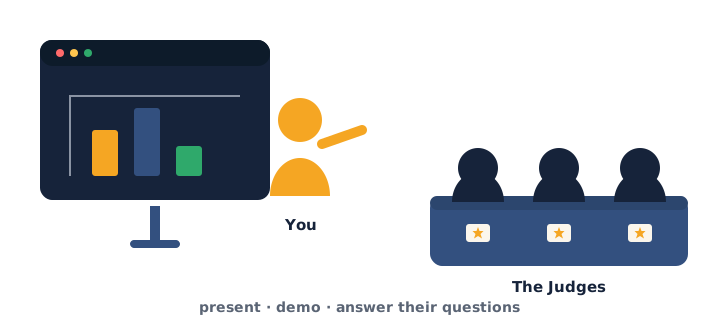
Ask yourself: which of the five steps is your project's strongest? Which is weakest? That tells you where to lean.
Teach — Present with confidence + handle questions
The delivery basics:
- Look at the panel, not the floor. Speak slowly.
- Show, don't just tell — a live demo beats any slide.
- Take a slow breath and stand tall for a few seconds before starting — it really settles nerves.
- If you're excited about the project, the panel will be too.
Now the Q&A: it's a conversation, not a trap. Prepare 3 likely questions and your answers in advance.
⚠ Watch for bluffing: you may feel you must have an answer for everything and be tempted to make things up. Don't — honesty impresses judges more. Keep these lines ready: "Great question — let me think," and if you truly don't know, "I'm not sure, but I'd find out by ___."
Try this now: guess the toughest question the panel might ask about your project. What's your honest answer?
Activity — The showcase
This is the finale — you present your work. It runs like a real panel.
How it flows (the running order):
- The format is set (1 min). The rules: each presenter gets ~3 minutes to present + 1–2 minutes of questions. The order is announced so everyone knows when they're up.
- A host runs the panel. You'll be introduced by name and project title, kept to time, and given a visible 30-second warning near the end of your talk.
- Presentations (rotating through the class). After each talk, there's a short Q&A — 1–2 questions from the host and from classmates.
- Feedback after each talk (fast and kind). You'll hear and give:
- One star: "The clearest part of that was ___."
- One wish: "One thing that would make it even stronger is ___."
- And a question to the presenter: "What are you proudest of in this project?"
- Everyone keeps to time. If a talk overruns, it gets a warm thank-you and moves on — protecting every student's slot is part of a fair showcase.
Tips to present well:
- If you're nervous, listen to the 30-second model first so you hear the structure and tone before your turn.
- When it's a classmate's turn, ask one question each — it keeps the panel engaged and generous.
- If your live demo crashes, cue your backup screenshot/video and keep calm — this happens to real engineers too.
- When giving feedback, always a genuine star before the wish, and only one wish so it lands.
Reflect: once everyone has presented, name one specific strength you saw across the whole class — including your own talk. You just did what real scientists and founders do: present, defend, and take questions.
Check yourself
Try these — say them aloud or write them down, then check your answers:
- What are the five steps of a strong talk? → Problem → Method → Demo → Results → What's next.
- A judge asks something you don't know. What do you do? → Say so honestly — "I'm not sure, but I'd find out by ___" — rather than bluff. Honesty impresses judges.
- What belongs in a project portfolio? → Your code, research report/paper, project or gadget, and presentation slides — a collection of your best work.
Wrap-up
- Build your portfolio: collect your Course 2 work into one folder — this is what universities and employers actually want to see:
- Your code (Colab links or screenshots).
- Your research report / paper.
- Your project or gadget (photos, Tinkercad link).
- Your presentation slides.
- One last reflection: what are you proudest of, and what will you build or research next?
Tips & extra challenges
- Watch out: you don't need an answer for every single question. Honesty beats bluffing — judges respect "I'd find that out by ___" far more than a guess that falls apart.
- Want more? Try this — prepare a research-panel-level defence and a shareable portfolio: treat the showcase like a real judged competition. (1) Rehearse a formal 3-minute talk that hits Problem → Method → Demo → Results → What's next, timed, with slides as signposts only. (2) Write out the five toughest questions a judge could ask about your method and evidence, and a solid honest answer to each — including how you'd find out what you don't yet know. (3) Prepare a one-page summary (your paper's abstract plus key chart) to hand judges. (4) Publish your portfolio online as a real link (Google Sites or GitHub) — code, report/paper, project photos, slides — the exact link you'd put on a university or program application. The goal is a talk that survives hard questions plus a live URL you can share today.
Vocabulary
| Term | Meaning |
|---|---|
| Panel | The judges you present to |
| Q&A | The question round |
| Portfolio | A collection of your best work |
| Poise | Calm confidence |
| Defend | Explaining your choices |
Resources
- Canva / Google Slides — polished slides.
- Presentation tips — a couple of short talks to watch.
- Google Sites — build a simple online portfolio (free).
Practice set
Practise on your own — presentation-skills drills to warm up before the showcase or after class. Model responses follow the arrow.
- The 30-second pitch. Compress your whole project into 30 seconds: problem, what you built, one result. → A strong answer names all three plainly — e.g. "Sorting recycling is slow, so I trained an image classifier that labels a photo as paper, plastic, or metal; it was right 82% of the time." If you can't do it in 30 seconds, the talk has no spine yet.
- Cut the wall of text. A slide has eight lines of full sentences. Fix it for a spoken talk. → Reduce to 3–5 key words or one image; the slide is a signpost, your voice carries the detail. Reading a full slide aloud loses the room.
- Answer the "I don't know." A judge asks something you genuinely can't answer. What do you say? → Honestly: "I'm not sure, but I'd find out by ___." Bluffing is easy to spot and costs trust; an honest, thoughtful answer impresses judges more.
- Handle the crash. Mid-demo, your live project freezes. What's the recovering move? → Calmly cue your backup screenshot or video and keep narrating — "here's it working from earlier." Always have a backup; a crash without one is the pitfall, not the crash itself.
- Fix the mumble. You catch yourself presenting fast, quietly, staring at the floor. Give yourself three concrete cues. → "Slow down, look at the panel not the screen, and pause for a breath between sections." A slow, steady voice reads as confidence even when nerves are high.
- Prepare the tough question. Name the single hardest question the panel could ask, and rehearse the answer aloud. → Any honest, specific answer is fine — the drill is that you've anticipated it. Preparing 3 likely questions turns Q&A from a trap into a conversation.
- Land the ending. A talk trails off with "…yeah, that's it." Replace it. → End on What's next and one line of pride: "Next I'd test it outdoors — and I'm proudest that it works on photos it's never seen." A clear final line is what the panel remembers.
Going deeper (optional)
Optional — for classes ready to go further.
The demo is the moment — build the talk toward it. Spend a minute on why a live demonstration beats every slide. A panel can read a results claim on a slide and half-believe it; watching the thing actually run in front of them is proof they can't argue with. Coach students to structure the talk so the demo is the peak, not an afterthought squeezed in at the end — set it up ("here's the problem"), then show it solving it, then explain the result. And precisely because it's the strongest moment, it's the one that fails most publicly: the students who rehearse the demo three times and prepare a backup video are the ones whose peak actually lands. The lesson: your best moment deserves your most preparation.
Q&A is a conversation, not an interrogation. Reframe the question round for nervous students. Judges ask questions because they're interested, not to catch them out — a good question means the project earned attention. The skill is a calm rhythm: hear the whole question, take a beat ("great question — let me think"), answer the part you know, and be honest about the part you don't. Model the difference live: a bluffed answer that falls apart under a follow-up versus an honest "I haven't tested that, but I'd expect ___ because ___." The second one, every time, reads as someone who genuinely understands their own work.
Common mistakes & fixes
If it's not working, check these:
- If you're reading every slide aloud word for word → Slides are signposts, not a script; put 3–5 key words on screen and let your voice and demo carry the story.
- If your slides are overcrowded — walls of text and tiny charts → One idea per slide, big readable visuals; if the panel is reading, they're not listening.
- If you have no backup for the demo → Always have a screenshot or short recorded video ready — a live demo will sometimes crash, and calm recovery is the mark of a real engineer.
- If you're tempted to bluff an answer you don't know → Say so honestly — "I'm not sure, but I'd find out by ___"; judges respect honesty far more than a confident guess that collapses.
- If you're rushing, mumbling, and staring at the floor or screen → Slow down, look at the panel, breathe between sections; steady delivery reads as confidence even when nervous.
What's next
Next: the bonus Generative-AI sessions (13–14).