
Session 5 — Think Like a Scientist
Duration: 75 min · Format: live online
What you'll learn: by the end, you can follow the research cycle, write a testable hypothesis in the "If , then , because ___" form, and design a fair test that changes only one thing.
Soft skill focus — Critical thinking
Today you'll also grow Critical thinking. A fair test is critical thinking made concrete — isolating one variable so you can actually tell what caused a result, instead of jumping to the easy conclusion.
- Try this: as you design your paper experiment, challenge any design that changes more than one thing at once, and ask "if it grew taller, how would I know it was the light and not something else?" — try to catch a hidden confounding variable.
- Think about: what could make you doubt the result of your own experiment?
What you'll need
- Paper and a pencil to design an experiment.
- A Google Sheet — a handy place to record and chart experiment data.
Hook
Think about these questions:
- "Why is the sky blue?"
- "Why do plants grow toward light?"
Take a guess at each. Here's the idea: every discovery in history started with a question and a good way to test it. This method is the most powerful tool humans ever invented — and today you learn to use it.
Teach — Research is a cycle
Scientists don't guess randomly — they follow a loop, over and over.
Look at this diagram and walk the loop through in your head:
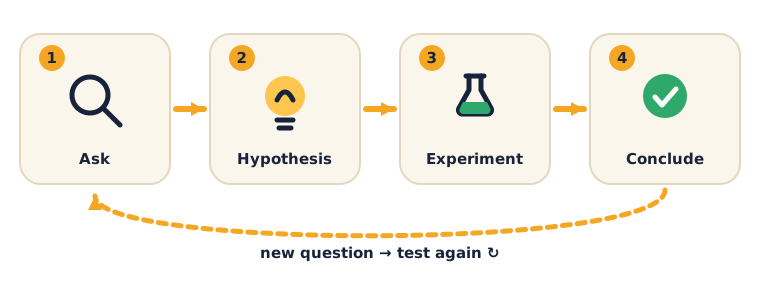
- Ask a clear question.
- Hypothesis — a smart guess you can test: "If , then , because ___."
- Experiment — test it fairly.
- Conclude — what did the data show? Then ask a new question and go again.
Key point: a hypothesis has to be testable — you must be able to run an experiment that could prove it right or wrong.
Think about: come up with a hypothesis about this classroom in the If… then… because… shape, then tighten it up.
Teach — A fair test changes ONE thing
To know what really caused a result, change only one thing and keep everything else the same.
Look at this diagram:
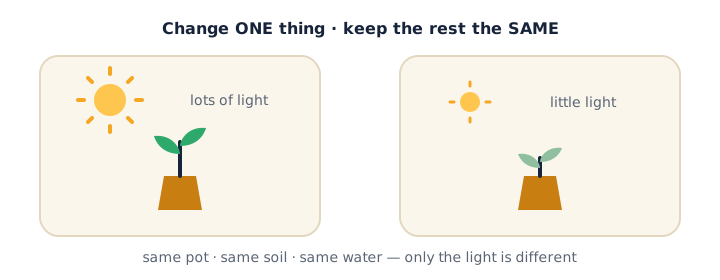
- The one thing you change = the independent variable (here: light).
- The thing you measure = the dependent variable (here: plant height).
- Everything kept the same = controlled variables (pot, soil, water).
⚠ Watch for the #1 mistake: it's tempting to change several things at once to "get results faster." Don't — if you change two things, you'll never know which one caused the result. One change at a time.
Ask yourself: "If I gave one plant more light and more water, and it grew taller — what caused it?" (Answer: we can't tell — that's not a fair test.)
Activity
Design an experiment on paper. Work through these four steps.
- Pick a question (e.g., Does music help me memorise better?).
- Write a hypothesis: "If , then , because ___."
- List the variables: what you'll change, what you'll measure, and what you'll keep the same.
- Write the steps so precisely that a friend could repeat the test exactly.
As you go, ask yourself: "What's my independent variable? What am I keeping the same?" If you're changing more than one thing, pick just one.
Check your design: read your hypothesis and variables back to yourself. A stranger should be able to run your steps and get the same kind of result — that's real research.
Check yourself
Try these — then check your answers:
- What makes a good hypothesis? → A testable guess, usually "If , then , because ___."
- In a fair test, how many things do you change at once? → One — the independent variable. Keep everything else the same.
- What is the dependent variable? → The thing you measure — the result you're watching for.
Wrap-up
- Name the four steps of the research cycle: Ask → Hypothesis → Experiment → Conclude.
- Try this at home — Run a tiny real experiment: pick something small (e.g., does warm water freeze faster than cold? or which paper-plane design flies furthest?). Change one thing, measure the result, and write a one-line conclusion. Bring it to Session 6.
Tips & extra challenges
- Watch out: don't "change lots of things to get results faster." Change one thing at a time — otherwise the result is meaningless.
- Want more? Try this — the "bulletproof experiment" challenge: turn your paper design into something a judge couldn't poke a hole in. (1) Name all three variable types clearly — independent, dependent, controlled — and list at least four controlled variables you'll hold constant; (2) plan to repeat each trial 3+ times and average, since one result could be luck; (3) add a control group (a version with no change) to compare against; (4) note how a bigger sample size means more trust, and estimate how many trials you realistically have time for; (5) sketch the results table you'll fill in before running anything; and (6) write a Method section so precise a stranger could copy it exactly. Then swap designs with a friend and try to find one flaw in each other's plan — finding the flaw is the real skill. This is exactly what competition judges look for in Unit 3.
Vocabulary
| Term | Meaning |
|---|---|
| Hypothesis | A testable guess |
| Variable | Something that can change |
| Fair test | Changing only one thing |
| Data | The measurements you collect |
| Conclusion | What the data tells you |
Resources
- Science Buddies — Scientific Method — clear guide + project ideas.
- NASA Science for Kids — real science, fun activities.
- Google Sheets — record and chart experiment data.
Practice set
Practise on your own — extra exercises to reinforce hypotheses, variables, and fair tests, easy → hard. Answers follow each arrow.
- Testable or not? "Cats are better pets than dogs." Is this a testable hypothesis? → No — "better" is an opinion with no measurable outcome; you can't design a fair test that proves it right or wrong.
- Fix the hypothesis. Rewrite "Plants like music" in the If… then… because… form. → e.g., "If I play music to a plant for 2 hours a day, then it will grow taller than a silent plant, because the vibrations may stimulate growth." (Any version with a clear change + measurable result is fine.)
- Name the variables. A student tests whether warmer water dissolves sugar faster. Identify the independent, dependent, and one controlled variable. → Independent: water temperature · Dependent: time for sugar to dissolve · Controlled: amount of water, amount of sugar, stirring (any one).
- Spot the flaw. "I gave Plant A more light and a bigger pot than Plant B. Plant A grew taller, so light makes plants grow." What's wrong? → Two things changed at once (light and pot size), so you can't tell which caused the growth — it's not a fair test.
- Design a fair test. You think a phone screen loses battery faster at full brightness. Design a fair test in 3 lines (change, measure, keep same). → Change: screen brightness (full vs. low) · Measure: % battery dropped in 30 min · Keep same: same phone, same app running, same starting charge, screen never touched.
- Why repeat? A friend flips a coin 4 times, gets 3 heads, and concludes the coin is unfair. What should they do instead? → Run many more trials (e.g., 100 flips) and average — a small sample can look lopsided by pure luck.
- Confounded or fair? To test if a fertiliser helps tomatoes, a gardener puts fertilised plants on a sunny windowsill and unfertilised ones in a shady corner. Fair? → Confounded — light differs too. Keep both groups in the same light and change only the fertiliser.
Going deeper (optional)
Optional — if you're flying through the fair-test idea.
Confounding variables — the sneaky third factor. Sometimes a test looks fair but a hidden variable rides along with the one you changed. Classic real example: a study once found towns with more ice-cream sales had more drownings — so does ice cream cause drowning? Think it through: the hidden variable is hot weather — heat drives both ice-cream sales and swimming. Ice cream and drowning move together (correlation) but neither causes the other (causation). Here's the phrase to carry into Unit 3: "correlation is not causation." Try inventing one more silly correlation (e.g., bigger shoe size → better reading; hidden variable = older age) so you can spot this trap in the papers you'll read next session.
Placebos and blind tests. Here's why medicine studies give some people a fake pill (a placebo). If people think they got the real treatment, they sometimes feel better anyway — so researchers keep subjects "blind" to which group they're in, isolating the true effect. It's the same fair-test logic — keep everything the same except the one thing you're testing, even people's expectations.
Common mistakes & fixes
- Mistake: Changing two or more things at once "to save time." → Fix: Change exactly one variable per test; run a separate test for each thing you want to check.
- Mistake: Writing a hypothesis that can't be measured (e.g., "the plant will be happier"). → Fix: Pick a measurable outcome — height in cm, time in seconds, number of leaves — so the result is a number you can chart.
- Mistake: Forgetting the controlled variables — only naming what you change and measure. → Fix: List everything you deliberately keep the same; those controls are what make the test fair.
- Mistake: Running the test once and treating that single result as proof. → Fix: Repeat each trial at least 3 times and average; one trial could easily be luck.
- Mistake: Deciding the answer first, then designing a test that can only confirm it. → Fix: Design a test that could genuinely prove you wrong — a real hypothesis is falsifiable, and disproving it is still a valid result.
What's next
Session 6 — Read Like a Scientist: you'll learn to navigate a real science paper, judge whether a source can be trusted, and summarise and cite what you read.