
Session 4 — What AI Can (and Can't) Do
Duration: 75 min · Format: live online
What you'll learn: by the end, you can name what AI is great at and where it struggles, explain bias as garbage in, garbage out, and make responsible choices as a builder.
Soft skill focus — Critical thinking
Today you'll also grow Critical thinking. "The AI decided" is never the end of the argument — judging where a system is trustworthy, and spotting how biased data quietly produces unfair results, is entirely a thinking skill.
- Try this: in the "Judge the AI" activity, don't settle for a Good use / Risky / Needs a human verdict without the reason behind it — name what could go wrong and whose data went in before you defend your answer.
- Think about: before you trust an AI's decision, what's the one question you'd ask about the data it learned from?
What you'll need
- Google Colab open in a tab for the practice coding tasks.
- Optional: Teachable Machine if you want to see bias happen by training an image model on unbalanced examples.
Hook
Think about these — would you trust an AI to:
- Recommend a song?
- Drive a school bus?
- Decide who gets a scholarship?
Some feel fine, some feel risky. Today you'll learn why that feeling changes — and how to tell the difference for real.
Teach — Superpowers and blind spots
AI is amazing at some things and surprisingly weak at others.
Look at this diagram and contrast the two panels:
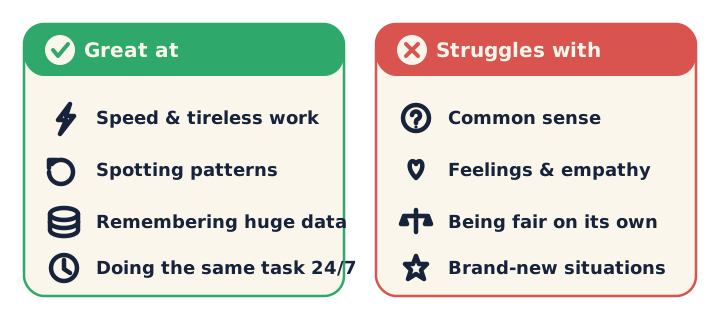
- Great at: speed, spotting patterns, remembering huge amounts, working 24/7 without tiring.
- Struggles with: common sense, real feelings, being fair on its own, and brand-new situations it never saw in its data.
Think about: can you name a task where AI's speed is a huge win — and one where its lack of common sense would be dangerous?
⚠ Watch for the key point: AI has no understanding and no feelings — it does math on patterns. That's why it can be brilliant and make silly mistakes a child never would. Don't fall into the trap of talking about the AI as if it "knows" or "cares."
Teach — Bias: garbage in, garbage out
A model only knows what it's shown. If the data is unfair, the model becomes unfair too.
Look at this diagram and trace how unbalanced data leads to a biased result:
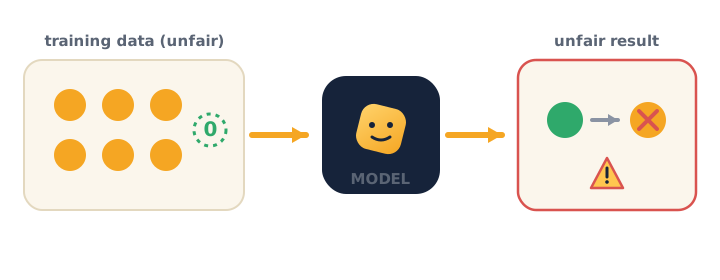
- Train a "cat detector" on only ginger cats → it may fail on black cats.
- Train a hiring AI on old, biased decisions → it repeats the same unfairness.
This is called bias, and fixing it starts with good, balanced data.
Think about: if you trained a face-unlock app using only photos of the team who built it, who might it fail for later? (Answer: anyone who doesn't look like that small group — the data wasn't representative.)
⚠ Watch for: it's easy to assume bias means someone was being deliberately mean. It usually isn't — bias creeps in through careless or unbalanced data, not bad intentions. That's why care with data matters.
Activity — Judge the AI
Judge each situation: Good use, Risky, or Needs a human — and say why. Take them one at a time and give a verdict plus a reason for each.
- Suggesting the next video to watch.
- Grading a student's final exam all by itself.
- Spotting tumours in X-rays to help (not replace) a doctor.
- Deciding who gets a bank loan.
Watch out for the pattern: the higher the stakes and the more it affects a person's life, the more a human needs to stay in charge.
Then take on the bias case: "A face-unlock app works great for the team who built it, but fails for many other people." Ask yourself: what went wrong with their data? (Answer: it wasn't balanced or representative — they trained on people who looked like themselves.)
Check yourself
Try these — then check your answers:
- Name one thing AI is great at and one it struggles with. → Great at: speed / patterns / memory. Struggles with: common sense / feelings / fairness / new situations.
- What is bias in AI? → When a model is unfair because it learned from unfair or unbalanced data — garbage in, garbage out.
- What's the best first step to reduce bias? → Use good, balanced, representative data — and have humans check important decisions.
Wrap-up
- This session completes the unit: you've learned to code in Python, wrangle data, build a predictive model, and use AI responsibly — genuine data-science skill.
- Finish the sentence: "A responsible AI builder always…"
- Try this at home — Spot the AI: find one AI you use (a recommendation feed, a voice assistant, autocorrect). Write 3 lines — one thing it does well, one thing it gets wrong, and one way its data might be biased.
Tips & extra challenges
- Watch out: don't assume "AI is objective, so it must be fair." A model is only as fair as its data — it can copy and amplify human unfairness without anyone intending it.
- Watch out: don't think bias means someone was malicious. It usually comes from unbalanced or careless data, not bad intent.
- Want more? Try this — an honest project report: real scientists document their work honestly, limits included. Write a short project report on the predictor you built last session, one line per section (below), then add a "fairness check": name one group the model saw little or no data about and one sentence on how you'd fix it. The finished report should read like something you could submit — this is exactly the format used for competitions later in the course. One line per section:
- Question — what were you trying to predict?
- Data — where it came from, how big, any gaps.
- Method — what model and features you used.
- Results — accuracy / error, with numbers.
- Limitations — where could it be wrong or biased? Who might it treat unfairly?
Admitting limitations isn't weakness — it's what makes work trustworthy, and this is exactly the report format used for competitions later in the course.
- Also want more? see bias happen: in Teachable Machine, train an image model on lots of one kind of example and very few of another, then watch it fail on the type it barely saw.
Vocabulary
| Term | Meaning |
|---|---|
| Capability | Something AI can do well |
| Limitation | Something AI can't do well |
| Bias | Unfairness learned from data |
| Fairness | Treating everyone equally |
| Responsible | Building safely and kindly |
Resources
- Elements of AI — a famous free course on what AI really is.
- Google — Teachable Machine — retrain a model with unbalanced data to see bias happen.
- MIT — AI ethics for youth — activities on responsible AI.
Practice set
Practise on your own — a mix of judgment questions and short coding tasks that make bias visible with the tools from this unit, easy to hard.
- Judge the AI: classify each as Good use, Risky, or Needs a human — recommending a playlist; approving a medical diagnosis alone; autocorrecting a text. → playlist = Good use; diagnosis alone = Needs a human; autocorrect = Risky (helpful but makes mistakes).
- Define it: finish the phrase "garbage in, ______ out" and say what it means for a model. → "garbage out" — a model trained on unfair or messy data produces unfair or wrong results.
- Spot the imbalance in code: this training set is meant to detect cats fairly. Print how many of each colour it contains, and say what's wrong. →
value_counts()shows 5 ginger vs 1 black; the data is unbalanced, so the model may fail on black cats.
import pandas as pd
cats = pd.DataFrame({"colour": ["ginger","ginger","ginger","ginger","ginger","black"]})
print(cats["colour"].value_counts())
- Reasoning: a face-unlock app was trained only on photos of the team that built it. Who is it likely to fail for, and what's the root cause? → anyone who doesn't resemble that small group; the cause is unrepresentative (biased) data, not bad intent.
- Fix the code + the bias: this loop is supposed to flag applicants for review but flags no one. Fix the bug, then explain a fairness risk. → bug:
=should be==insideif. Fairness: if the pastdecisionswere themselves biased, the model just repeats them.
decisions = ["approve", "deny", "approve"]
for d in decisions:
    if d = "deny":            # bug here
        print("needs review")
- Balance-check (harder): given
labels = ["yes","yes","yes","yes","no"], write a couple of lines that print how many of each there are, using a loop orvalue_counts. → e.g. a dict/loop, orpd.Series(labels).value_counts()→yes 4, no 1; point out the imbalance. - Design question (hardest): you're building an AI to pick scholarship winners. Name two things you'd do to keep it fair. → e.g. use balanced, representative data across schools/regions; keep a human in charge of the final decision; document limitations; test the model on groups separately.
Going deeper (optional)
If you're flying through this, make bias measurable rather than abstract. Suppose you have model predictions alongside the group each person belongs to, and you want to see if accuracy is equal across groups — a real fairness metric:
import pandas as pd

df = pd.DataFrame({
    "group":   ["A","A","A","B","B","B"],
    "correct": [1,   1,   1,   1,   0,   0]   # 1 = model got it right
})

print(df.groupby("group")["correct"].mean())
groupby splits the rows by group, and .mean() of the 1/0 column is the accuracy for each. Here group A scores 1.0 but group B only 0.33 — the same model is far less reliable for group B, which is exactly what unfairness looks like in numbers. The lesson: a single overall accuracy can hide bias; checking each group separately is how responsible builders catch it.
Common mistakes & fixes
- Mistake: believing "AI is objective, so it must be fair." → Fix: a model is only as fair as its data; it can copy and amplify human unfairness with no one intending it.
- Mistake: thinking bias means someone was deliberately malicious. → Fix: bias usually creeps in through unbalanced or careless data, so careful data collection is the first defence.
- Mistake (code): using
=instead of==inside anif, e.g.if d = "deny":. → Fix: comparison needs double equals:if d == "deny":. A single=stores a value and errors here. - Mistake: judging fairness by a single overall accuracy number. → Fix: break the score down by group (e.g.
groupby) — high overall accuracy can still hide poor performance for some people. - Mistake: assuming more data automatically means fairer results. → Fix: it must be balanced and representative — a million photos of one group is still biased data.
What's next
Unit 2 — Research & Engineering: you'll become a researcher and maker — how science works, reading and writing it, and building electronics with Arduino.