
Unit 3 Project — A Research Study
Run after: Sessions 9–12 · Format: independent project
Your goal: run a small but genuinely rigorous study — a clear question, a fair method, honest evaluation with proper metrics, and a real reflection on ethics and bias.
What to build
A short research report (with the code or notebook behind it) that investigates one focused question the way a real researcher would. This isn't about a flashy demo — it's about doing the method properly: forming a hypothesis, testing it fairly, measuring with the right metrics, and being honest about what your results do and don't show.
The best studies here are small and tight. A narrow question answered rigorously beats a huge one answered sloppily. Your reader should be able to trust your conclusion because they can see exactly how you reached it.
Example ideas (pick one, or bring your own):
- Does more data help? — train the same model on 25%, 50%, and 100% of a dataset and measure how accuracy changes.
- Fair test of two methods — compare two models (or two settings) on the same held-back data, with the right metric and a note on whether the gap is real.
- Reproduce a claim — take a result from a tutorial or paper and check whether you can reproduce it; report honestly if you can't.
- Bias probe — measure whether a model performs worse for one group than another, and quantify the gap.
- Metric matters — show a case where accuracy looks great but precision/recall (or a confusion matrix) tells a different, truer story.
Steps
- Ask one clear question and state a hypothesis — what you expect and why.
- Design a fair method — control what needs controlling, hold back a test set, decide your metric before you look at results.
- Run the study, keeping notes and enough detail that someone could repeat it.
- Measure with the right metrics — not just accuracy; use precision, recall, or a confusion matrix where they fit.
- Judge honestly — does the evidence actually support your hypothesis? Is the difference real or noise?
- Reflect on ethics and bias — who could be affected, what could go wrong, what's fair and unfair about your data and result.
- Write the report with proper sections.
Report more than accuracy — the full picture:
from sklearn.metrics import classification_report, confusion_matrix

predictions = model.predict(X_test)
print(confusion_matrix(y_test, predictions))
print(classification_report(y_test, predictions))
# Precision and recall per class often reveal what a single accuracy number hides.
Deliverables
A research report (2–4 pages, or a well-structured notebook) plus the code behind it, containing, in order:
- a clear question and hypothesis,
- a method described well enough to reproduce, with your test set and chosen metric,
- honest results with the right metrics (a table or chart, not just one number),
- an ethics & bias reflection — who's affected and what's fair,
- a short conclusion stating what you can and cannot claim.
Here is how your work is assessed — four rising levels:
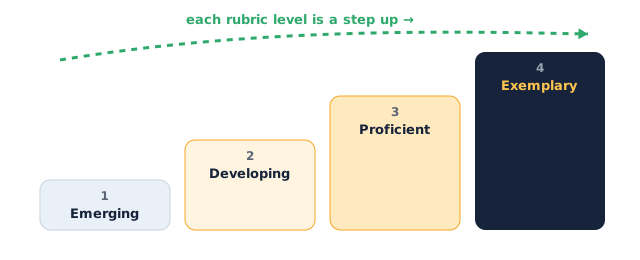
How your work is assessed
| Criterion | Emerging | Developing | Proficient | Exemplary |
|---|---|---|---|---|
| Clear question / hypothesis | Vague or missing | Question present, no hypothesis | Focused question with a real hypothesis | Original, well-scoped question worth answering |
| Sound method | Unfair or broken | Method has clear gaps | Fair test: held-back data, controlled variables | Rigorous and repeatable — others could reproduce it |
| Honest evaluation | Wrong or no metrics | One metric, unexamined | Right metrics reported and interpreted | Analyses signal vs. noise; knows what the numbers mean |
| Ethics reflection | Missing | Generic mention of bias | Names a real bias and who it affects | Quantifies the harm and suggests how to reduce it |
| Report | Incomplete | Most sections, weak writing | Full sections, clear and honest | Publication-style: precise, well-argued, well-cited |
What's next
Your study is a portfolio piece in its own right — and a template for the ambition of the Course Capstone ahead.