
Unit 2 Project — Build with Modern AI
Run after: Sessions 5–8 · Format: independent project
Your goal: build something genuinely useful on top of modern AI — embeddings, a pre-trained transformer, or an LLM with retrieval (RAG) — and use it responsibly, with an eye on privacy and where it can go wrong.
What to build
A working tool or study that puts modern AI to real use — not a model trained from scratch, but a smart application built on models that already exist. You'll use Hugging Face pipelines, sentence embeddings, or an LLM, and wrap them into something a person could actually try.
The heart of this project is meaningful use: the AI should do real work in your tool, and you should be able to show it running and explain what it's doing. You'll also think like a responsible builder — what data goes in, what could be misused, and what you'd warn a user about.
Example ideas (pick one, or bring your own):
- Semantic search — embed a collection of texts (song lyrics, recipes, your notes) and let a user search by meaning rather than exact words.
- Smart classifier — use a pre-trained transformer to sort reviews, messages, or emails by sentiment or topic, and evaluate it on your own labelled examples.
- Summariser — build a tool that turns long articles into short, faithful summaries, and check whether the summaries stay true to the source.
- Grounded assistant (RAG) — feed an LLM a small set of documents you trust and build a question-answerer that cites where its answers came from.
- Compare two models — run the same task through two pre-trained models and report which is better and why.
Steps
- Pick a real task and a user. Say who this helps and what they'd type or upload.
- Choose your modern-AI ingredient — embeddings, a Hugging Face pipeline, or an LLM + retrieval — and get a first version running.
- Feed it real inputs and see where it shines and where it breaks.
- Make it usable — a simple loop, notebook cells, or a small Gradio interface.
- Test it honestly on a handful of your own examples; note the failures, don't hide them.
- Do a responsible-use check — what private data is involved, what could be misused, and what a user should be told.
- Write it up — what it does, how well, and its limits.
A grounded-answer sketch using embeddings + an LLM:
from sentence_transformers import SentenceTransformer, util

embedder = SentenceTransformer("all-MiniLM-L6-v2")
docs = ["...your trusted documents..."]
doc_vecs = embedder.encode(docs, convert_to_tensor=True)

question = "What does the policy say about refunds?"
q_vec = embedder.encode(question, convert_to_tensor=True)
best = util.semantic_search(q_vec, doc_vecs, top_k=2)[0]

context = "\n".join(docs[hit["corpus_id"]] for hit in best)
# Pass `context` + `question` to your LLM so its answer is grounded — and cite the source.
Deliverables
A shareable package (a Colab notebook, or a repo with a short README, or a small Gradio/Streamlit demo) that contains, in order:
- what the tool does and who it's for, in a sentence or two,
- the modern-AI component clearly used and working,
- a handful of real example runs, including at least one honest failure,
- a short responsible-use & privacy note (what data is involved, what could go wrong, what you'd warn users),
- a brief write-up of how well it works and its limits.
Here is how your work is assessed — four rising levels:
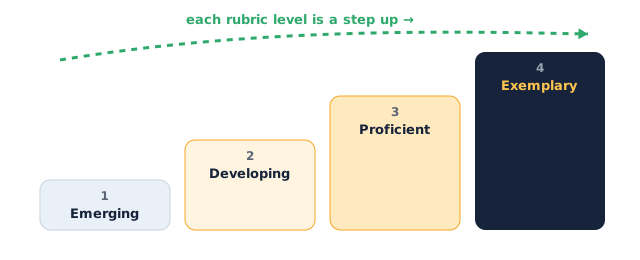
How your work is assessed
| Criterion | Emerging | Developing | Proficient | Exemplary |
|---|---|---|---|---|
| Uses modern AI meaningfully | AI barely used | Used, but it's not the point | Embeddings / transformer / LLM does real work | Used cleverly; the right tool for the task, well applied |
| Works | Doesn't run | Runs on one input only | Handles real inputs and gives useful output | Robust, usable, handles tricky inputs gracefully |
| Responsible use & privacy | Not considered | Mentioned vaguely | Names real data and misuse risks | Thoughtful safeguards and honest user warnings |
| Creativity | Copy of a tutorial | Small twist on an example | A genuinely useful, original idea | Inventive and polished — something people would use |
| Write-up | Missing | States what it does only | Clear write-up with honest limits | Insightful reflection on strengths, failures, and next steps |
What's next
In Unit 3 you'll turn the same skills toward a question you actually want answered — and hold your own work to a researcher's standard.