Course Capstone — Research & Innovation Portfolio
Run after: Sessions 1–16 · Format: independent project, over several sessions
Your goal: build one substantial research-or-innovation project and package it like a professional — a clean GitHub repo, clear write-ups, a deployed demo where possible, and a confident presentation. This is the piece you'll show on a university application.
What to build
A serious, end-to-end project that pulls together everything in this course — deep learning, modern AI, and rigorous research — into work you're proud to keep. You choose the direction: a research study that answers a real question, or an innovation that builds a genuinely useful AI tool. Either way, you take it from idea to finished, deployed, presentable work.
This is your best work, done with time to revise. Aim high: something a university admissions reader or a competition judge would find genuinely impressive — not because of a big number, but because of the care, honesty, and craft behind it.
Example directions (pick one, or bring your own):
- Research route — a deep-learning or modern-AI study that answers a real question with a fair method, proper metrics, and an ethics reflection, written up like a paper.
- Innovation route — a deployed AI tool (classifier, assistant, summariser, search engine) that solves a real problem for a real user, live for anyone to try.
- Reproduce-and-extend — reproduce a published result, then push it one honest step further.
Steps
- Choose an ambitious but finishable direction and write a short proposal — your question or product, why it matters, your plan, and what you'll ship.
- Do background reading and cite one or two solid sources.
- Build it — train, evaluate, and iterate. Keep records; commit to GitHub as you go.
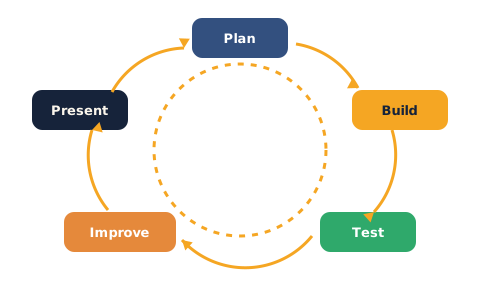
- Test and improve — go around the project cycle: build, test, learn, refine.
- Deploy a demo where possible (Gradio / Streamlit / Hugging Face Spaces) so anyone can try it.
- Write it up — a clear report and a README that lets a stranger understand and run your work.
- Present — a short, confident talk with slides, then questions.
Deliverables
A portfolio-ready package with four parts:
- a GitHub repository — clean, documented, with a README explaining what it is and how to run it,
- a deployed demo link (Gradio / Streamlit / Spaces) where the project allows it,
- a short report (2–5 pages) — question or product, method, honest results with the right metrics, limitations, and references,
- a presentation — a 5-minute talk with slides, followed by questions.
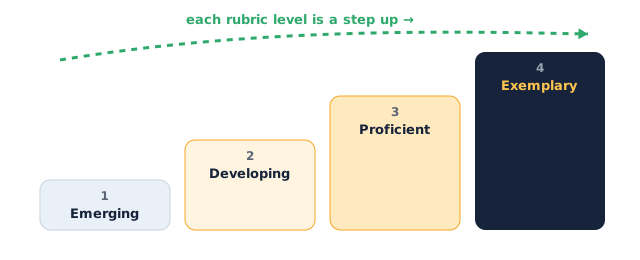
Here is how your work is assessed — four rising levels:
How your work is assessed
| Criterion | Emerging | Developing | Proficient | Exemplary |
|---|---|---|---|---|
| Ambition & scope | Trivial or unfinished | Modest, plays it safe | Substantial, well-scoped project | Genuinely ambitious and fully realised |
| Technical execution | Doesn't work | Works partially | Sound method / working product, done right | Rigorous and polished — professional-grade work |
| Evidence & honesty | No real evidence | Weak or one-sided | Right metrics, honest results and limits | Insightful analysis; limits and next steps clear |
| Repository & write-up | Missing or unusable | Runs but undocumented | Clean repo, clear README and report | Anyone could read, run, and build on it |
| Deployed demo | None | Broken or local only | A working, shareable demo (where feasible) | Polished, robust demo anyone can try |
| Presentation | Reads slides, unclear | Understandable but flat | Clear, paced, answers questions | Confident and compelling; handles hard questions |
What's next
When your portfolio is complete, see the Certificate & Assessment Criteria to learn how this work earns your Future Builders certificate — and how far you can take it.